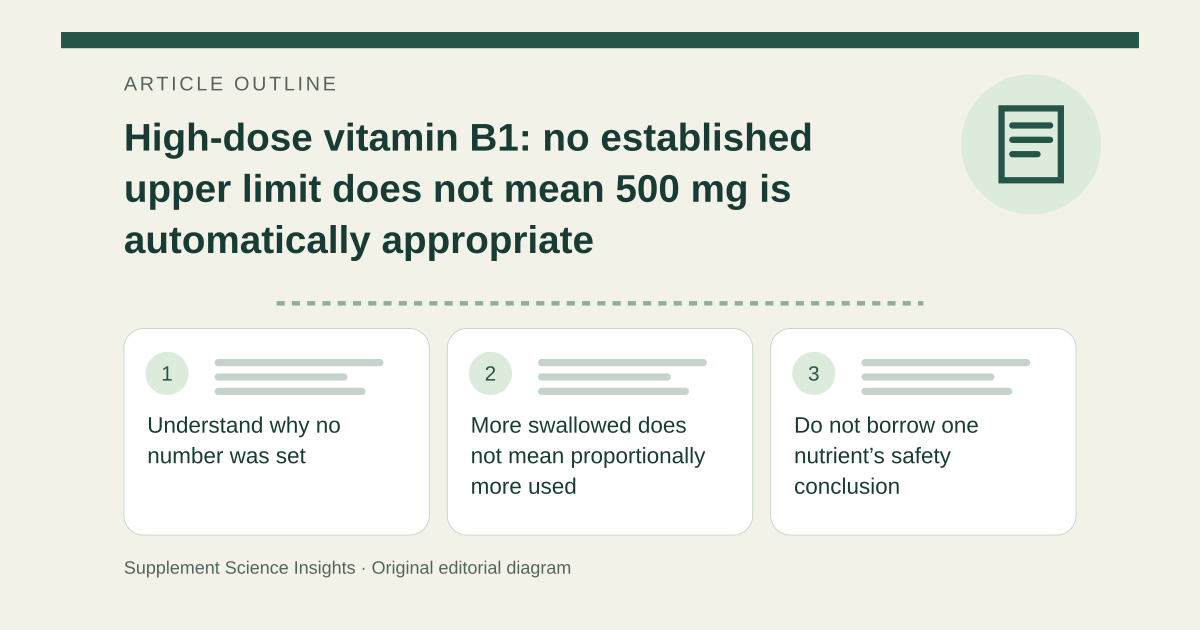
Understand why no number was set
ODS explains that the Food and Nutrition Board did not establish a thiamin upper limit because reports of adverse effects from high oral intakes were lacking. The same discussion cautions that excessive intakes could still have adverse effects. [1]
A missing upper-limit number is therefore not a clinical recommendation. It does not establish that a 500 mg product is necessary, beneficial or interchangeable with treatment prescribed for a particular deficiency-related condition. [1]
More swallowed does not mean proportionally more used
The body excretes excess thiamin in urine, and absorption becomes less efficient at higher intakes. These mechanisms help explain tolerability observations but do not show that escalating the dose improves an outcome. [1]
Separate the reason for treatment from a retail strength. A clinician-directed regimen for a specific condition should not be copied simply because the same vitamin is sold without a prescription. Other ingredients in a B-complex product also require their own assessment; thiamin’s limit status cannot be assigned to the whole mixture. [1]
Do not borrow one nutrient’s safety conclusion
Imagine a B-complex contains high thiamin and high vitamin B6. The absence of a thiamin UL says nothing about the safety of the B6 amount. Each ingredient and total exposure needs to be evaluated separately.
| Observation | What it establishes |
|---|---|
| Thiamin has no established UL | Limited basis for setting a numerical cap |
| 500 mg on a label | A product strength, not an indication |
| Other B vitamins | Different safety evidence |
Sources for this article
- NIH ODS: Thiamin — Health Professional Fact Sheet
Source consulted: 2026-09-17. This is a reference resource, not a claim that we conducted the studies or tested a product.