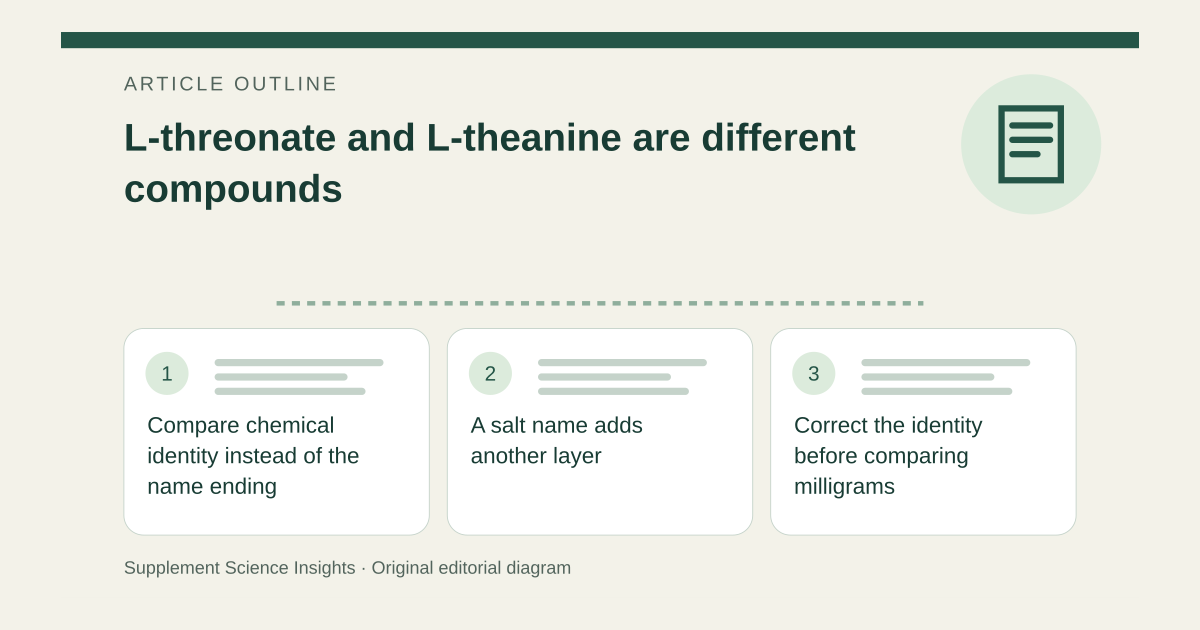
Compare chemical identity instead of the name ending
ChEBI defines L-threonate as the conjugate base of L-threonic acid, with formula C4H7O5 and a negative charge. It defines L-theanine as N5-ethyl-L-glutamine, with formula C7H14N2O3. [1][2]
The second structure contains nitrogen; the first formula does not. These are distinct chemical entities, not alternate brand names for one ingredient. [1][2]
A salt name adds another layer
When a label names a threonate salt, identify the complete salt and the nutrient amount separately. Do not replace the word threonate with theanine when comparing a label to research. [1][2]
Neither similarity in spelling nor a shared L prefix establishes equal effects, dose or interchangeability. Clinical comparisons need evidence for the exact substance. [1][2]
Correct the identity before comparing milligrams
Imagine one label lists L-theanine and another lists a threonate salt. Comparing only the number of milligrams skips the basic question of what each amount measures.
| Detail | Interpretation |
|---|---|
| L-threonate | L-threonic acid conjugate base |
| L-theanine | Ethylated glutamine derivative |
| Similar spelling | Not chemical equivalence |
Sources for this article
- L-threonate (CHEBI:57561)
Source consulted: 2026-09-18. This is a reference resource, not a claim that we conducted the studies or tested a product. - N(5)-ethyl-L-glutamine (CHEBI:17394)
Source consulted: 2026-09-18. This is a reference resource, not a claim that we conducted the studies or tested a product.