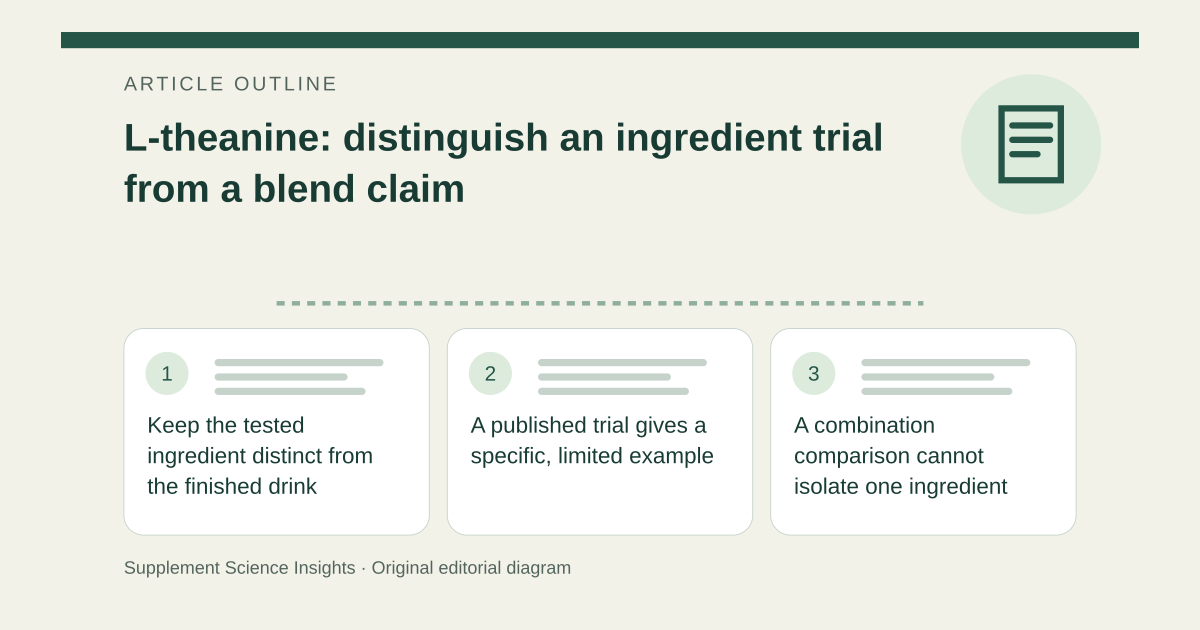
Keep the tested ingredient distinct from the finished drink
L-theanine is a non-protein amino acid found in tea. A supplement containing it alone, a tea preparation and a blend containing caffeine are different interventions. Preserve the actual ingredients when recording a study or a product claim. [1]
A shared ingredient does not make preparations interchangeable. Ask whether the supporting study tested the same combination and whether the advertised outcome was actually measured. Do not transfer a result for a blend to each ingredient individually. [1]
A published trial gives a specific, limited example
Hidese and colleagues reported a 2019 randomized, double-blind, placebo-controlled crossover trial involving 30 adults without major psychiatric illness. Participants received L-theanine and placebo in separate four-week periods, separated by a washout. The paper assessed several symptom and cognitive measures. [1]
The trial was funded by Taiyo Kagaku; two authors were company employees, and the company supplied the tablets. The authors acknowledged the small sample and unaccounted-for factors such as diet and tea consumption. These details belong beside any interpretation of the results. [1]
A combination comparison cannot isolate one ingredient
Imagine a fictional trial comparing a drink containing L-theanine plus caffeine with a placebo drink. If the combination performed differently, that comparison alone would not identify which ingredient produced the difference or whether their combination mattered.
Separate L-theanine-only and caffeine-only arms would address different questions. The table below shows the missing comparisons; it does not describe the Hidese trial, report an observed benefit or propose a supplement ratio.
| Comparison | Question it addresses |
|---|---|
| L-theanine + caffeine versus placebo | Effect of the combination under study conditions |
| L-theanine alone versus placebo | Effect of L-theanine under study conditions |
| Caffeine alone versus placebo | Effect of caffeine under study conditions |
| Combination versus its individual components | Whether the combination differs from either component |
Ask whether the result is a between-treatment difference
Improvement from a participant’s own starting score is not the same as improvement relative to placebo. Keep those analyses separate when reading an abstract. Also distinguish a planned main outcome from subgroup or exploratory findings. [1]
A crossover study observes the same people under different conditions. The 30 people in the cited trial do not become 60 independent participants because both treatments were assessed. Consider treatment order, washout and the analysis of repeated observations before drawing conclusions. [1]
A short adult trial cannot answer every safety question
This small study does not establish long-term safety or suitability in children, pregnancy or people with medical conditions excluded from enrollment. Do not convert a lack of a prominent warning in a product description into a clinical safety finding. [1][2]
Discuss the actual preparation, other ingredients and medicines with a qualified clinician when considering use. Keep caffeine-containing blends visible in that discussion. This page supplies no treatment protocol or advice to replace care for persistent anxiety or sleep problems. [1][2]
This is a study-reading example, not a consensus review
The original paper’s methods, limitations and funding were inspected for this article. Its inclusion illustrates appraisal questions; it is not a claim that one trial establishes an effective treatment or validates a retail brand.
No clinical effect size or optimal dose is recommended here. The wider literature, subsequent studies and correction history have not been comprehensively reviewed. Independent scientific and editorial acceptance remains pending.
Sources for this article
- Hidese et al. (2019) — Effects of L-Theanine Administration on Stress-Related Symptoms and Cognitive Functions in Healthy Adults: A Randomized Controlled Trial
Source consulted: 2026-09-17. This is a reference resource, not a claim that we conducted the studies or tested a product. - NIH ODS — Dietary Supplements: What You Need to Know
Source consulted: 2026-09-17. This is a reference resource, not a claim that we conducted the studies or tested a product.
Considering a supplement?
Ingredient evidence alone does not establish which retail product is suitable. No single featured product is recommended for this article.
Compare l-theanine formulations (retail checks pending) → No overall winner
Compare formulations → · How we select products