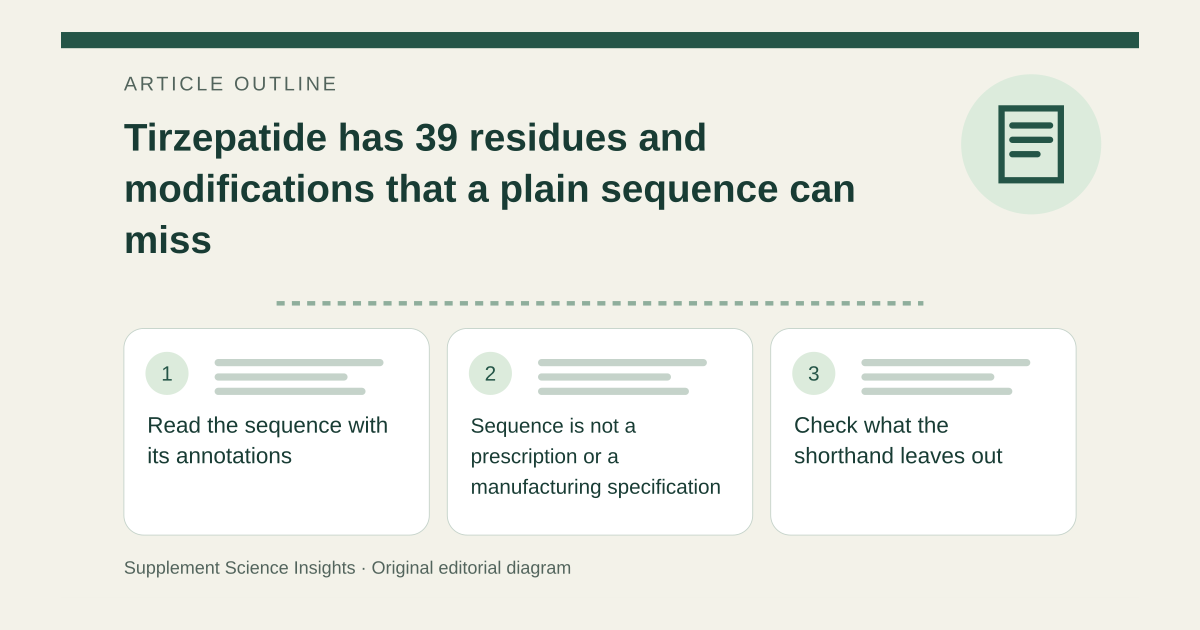
Read the sequence with its annotations
The residue order is Tyr–Aib–Glu–Gly–Thr–Phe–Thr–Ser–Asp–Tyr–Ser–Ile–Aib–Leu–Asp–Lys–Ile–Ala–Gln–Lys*–Ala–Phe–Val–Gln–Trp–Leu–Ile–Ala–Gly–Gly–Pro–Ser–Ser–Gly–Ala–Pro–Pro–Pro–Ser–NH2. [1][2]
Aib is aminoisobutyric acid at positions 2 and 13. The asterisk marks Lys20, whose side chain carries a linker to 1,20-eicosanedioic acid. NH2 denotes the C-terminal amide. [1][2]
Sequence is not a prescription or a manufacturing specification
The FDA description confirms that these modifications are part of the molecule. The cited patent provides residue-order corroboration; a patent is not clinical proof of efficacy or a product-quality certificate. [1][2]
This structural explanation uses the 2022 label for chemical identity, not for current prescribing instructions. A loose amino acid mixture does not reproduce the medicine. [1][2]
Check what the shorthand leaves out
Imagine a sequence list replaces Aib with alanine and omits the Lys20 modification. Even if the residue count remains 39, it no longer fully describes tirzepatide.
| Detail | Interpretation |
|---|---|
| Positions 2 and 13 | Aib |
| Position 20 | Modified lysine |
| C terminus | Amide |
Sources for this article
- Review
Source consulted: 2026-09-18. This is a reference resource, not a claim that we conducted the studies or tested a product. - US20250019410A1 - Process for the preparation of tirzepatide or pharmaceutically acceptable salt thereof
- Google Patents
Source consulted: 2026-09-18. This is a reference resource, not a claim that we conducted the studies or tested a product.