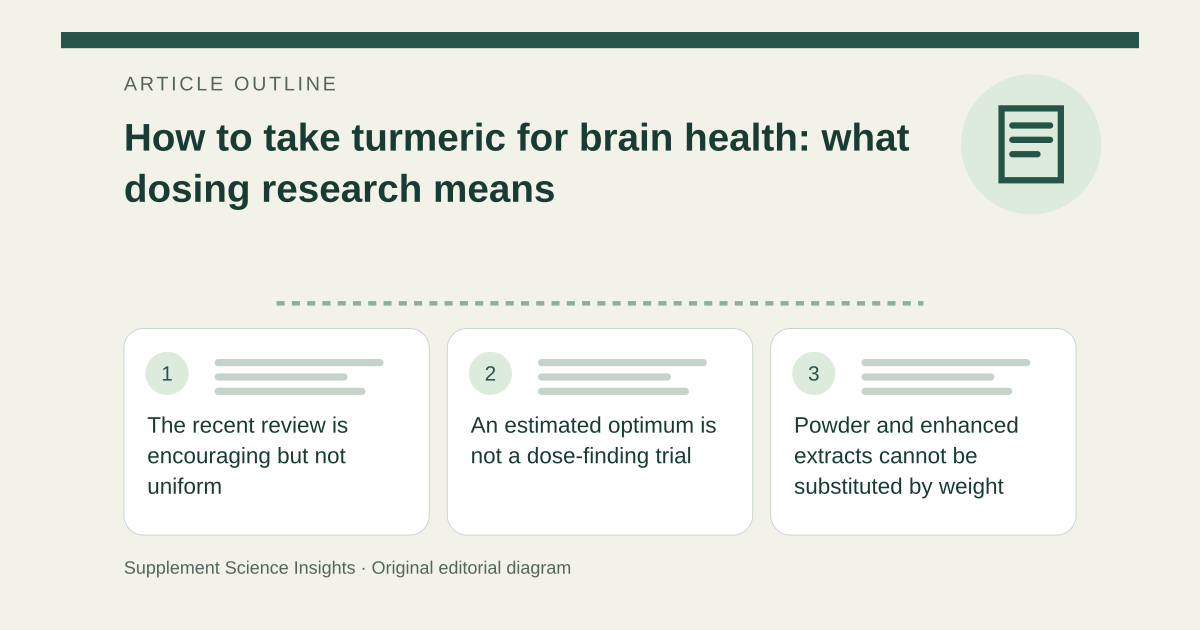
The recent review is encouraging but not uniform
The review combined nine randomized trials involving 501 participants. Global cognitive scores improved overall, whereas earlier meta-analyses had not found a significant overall effect. The included populations ranged across different ages and health conditions, limiting transfer to a generic brain-boosting claim. [1]
An estimated optimum is not a dose-finding trial
The authors modeled a nonlinear relationship and proposed 0.8 grams of curcumin daily as an optimum. However, that analysis used only twelve comparisons across a wide dose range, which the authors acknowledged limits precision. It is not a direct randomized comparison establishing the best dose for a particular person or product. [1]
Powder and enhanced extracts cannot be substituted by weight
A gram of turmeric powder is not a gram of curcumin. Different absorption technologies also change exposure. The review cannot establish a teaspoon conversion or prove that a stronger formulation produces better cognition. NCCIH reports liver injury with some enhanced products. [1][2]
Cognitive test changes are not dementia prevention
A study score does not by itself demonstrate prevention of Alzheimer disease or preservation of daily independence. NIA guidance emphasizes attention to health conditions, medicine effects, activity and social engagement; no supplement is currently recommended as a proven prevention strategy for cognitive decline or Alzheimer disease. [3][1]
Match the question to the person
Imagine a healthy younger adult applies a favorable older-adult subgroup result to exam performance. The age group, outcome and time scale differ. Persistent memory concerns deserve assessment, while a research dose estimate should be discussed in context rather than copied as a self-treatment regimen. [1][3]
| Claim | What remains unresolved |
|---|---|
| 0.8 grams modeled optimum | Best dose for an individual |
| Improved global test score | Dementia prevention |
| Enhanced absorption | Better benefit-to-risk balance |
| Older-adult subgroup benefit | Exam performance in younger adults |
Sources for this article
- The effect of curcumin supplementation on cognitive function: an updated systematic review and meta-analysis - PMC
Source consulted: 2026-09-21. This is a reference resource, not a claim that we conducted the studies or tested a product. - Turmeric: Usefulness and Safety | NCCIH
Source consulted: 2026-09-21. This is a reference resource, not a claim that we conducted the studies or tested a product. - NIA Cognitive Health and Older Adults
Source consulted: 2026-09-21. This is a reference resource, not a claim that we conducted the studies or tested a product.