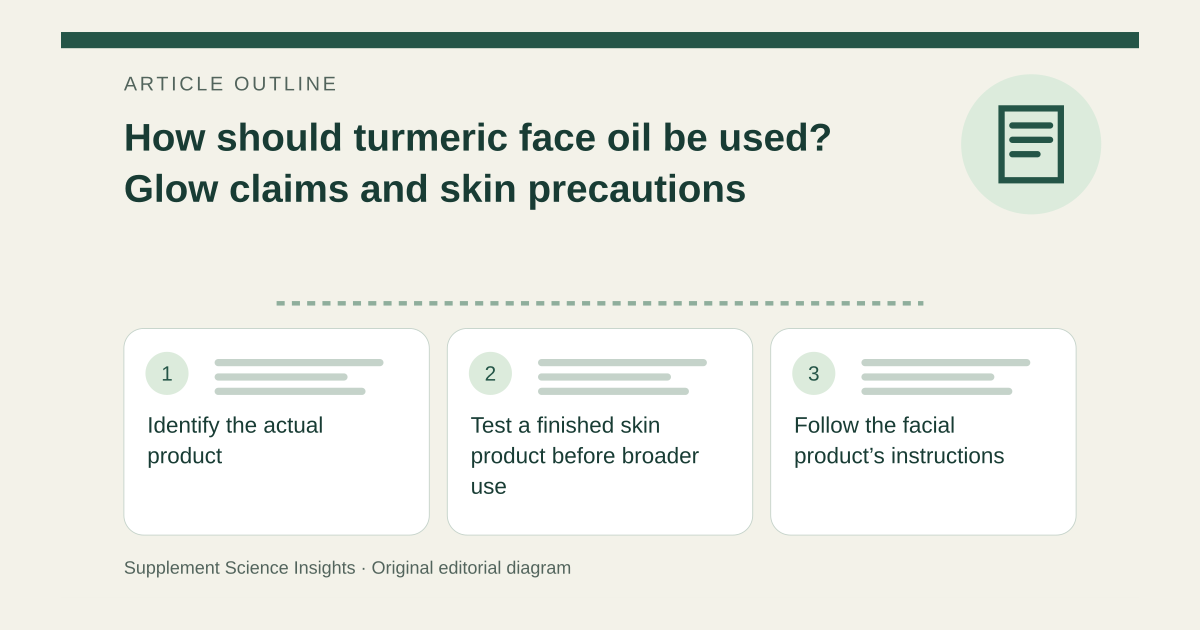
Identify the actual product
Read whether the bottle contains a carrier-oil blend, essential oil or another extract, and whether the manufacturer intends it for facial use. Essential oil contains a volatile mixture distinct from curcumin. The shared name turmeric does not establish the same concentration or directions. [1][2]
Test a finished skin product before broader use
AAD advises testing the normal amount on a small area such as the inner arm twice daily for seven to ten days, respecting rinse-off directions. This can reveal a reaction but cannot guarantee that every facial area will tolerate it or prove that it works. Avoid improvising dilution for a product not intended for skin. [3][2]
Follow the facial product’s instructions
Use the specified amount and frequency, keep it away from areas the label excludes and avoid damaged or inflamed skin. Do not transfer a body-oil, food-oil or aromatherapy instruction to the face. More frequent or overnight use is not an evidence-based way to accelerate a glow claim. [2][3]
Interpret appearance changes carefully
The skin review includes varied conditions and formulations, not proof for every turmeric face oil. A surface sheen or temporary staining is different from improving acne, texture or hyperpigmentation. Persistent concerns are better addressed through diagnosis and a suitable skin-care plan. [4][5]
Stop a reaction
Imagine the face looks shinier but also becomes itchy and red. Wash the product off and stop using it; seek medical advice if the reaction is severe or persists. Irritation is not evidence that the oil is stimulating useful renewal. [3]
| Check | Purpose |
|---|---|
| Intended facial use | Avoid substituting a different route |
| Full formula | Identify essential oil and other ingredients |
| Small-area test | Screen for intolerance |
| Directions and response | Avoid escalation after irritation |
Sources for this article
- Curcuma longa L. Rhizome Essential Oil from Extraction to Its Agri-Food Applications. A Review - PMC
Source consulted: 2026-09-21. This is a reference resource, not a claim that we conducted the studies or tested a product. - Essential oils: Poisonous when misused | Poison Control
Source consulted: 2026-09-21. This is a reference resource, not a claim that we conducted the studies or tested a product. - How to test skin care products
Source consulted: 2026-09-21. This is a reference resource, not a claim that we conducted the studies or tested a product. - Evaluation of curcumin for dermatologic conditions: a systematic review.
Source consulted: 2026-09-21. This is a reference resource, not a claim that we conducted the studies or tested a product. - Turmeric: Usefulness and Safety | NCCIH
Source consulted: 2026-09-21. This is a reference resource, not a claim that we conducted the studies or tested a product.