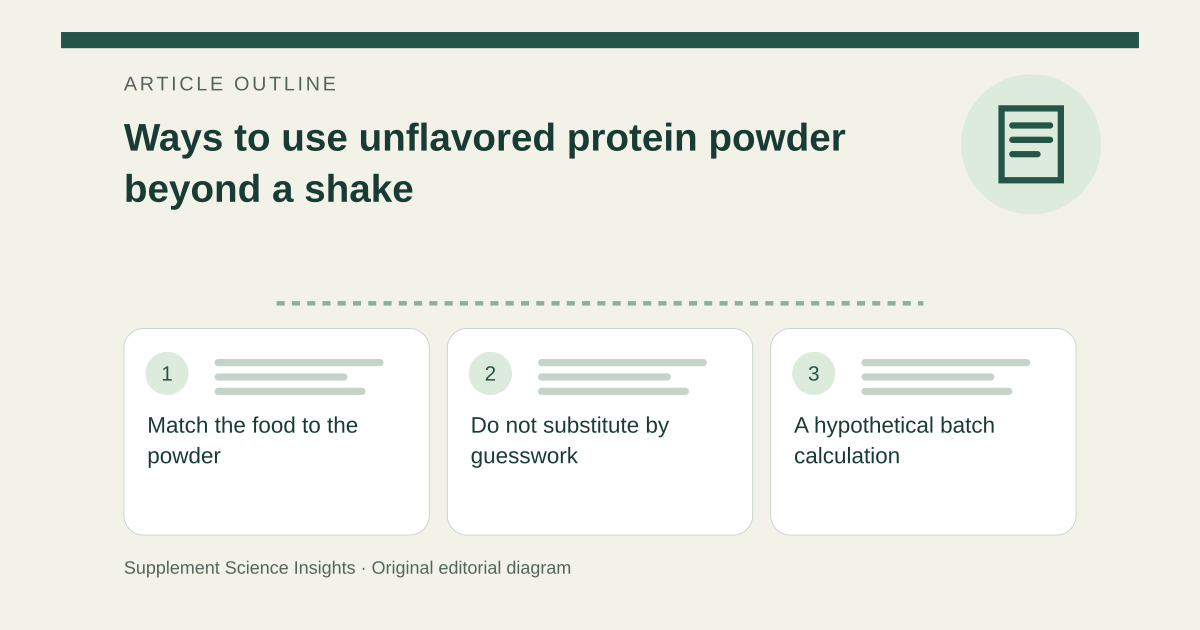
Match the food to the powder
Original preparation ideas include blending a measured portion into a smoothie, stirring it into yogurt, mixing it into prepared oatmeal or incorporating it into a recipe designed for added protein. An unflavored powder is not necessarily neutral in taste, and its thickening behavior varies. These suggestions are culinary examples, not evidence that a particular preparation improves health. [1]
Do not substitute by guesswork
Adding powder changes the solids and liquid balance, so it should not automatically replace flour gram for gram. Start from a suitable recipe or manufacturer directions. Milk-based powder remains milk-derived when mixed with water, and a dairy-free liquid does not remove an allergen already present in the powder. [2]
A hypothetical batch calculation
Suppose a measured powder portion contributes24 g protein to a recipe divided into four equal portions. The powder contributes6 g per portion, before protein from other ingredients. Unequal portions or leftover batter change the amount eaten. This method works whether the finished food is sweet or savory; the container’s serving size does not automatically become one serving of the recipe. [1]
| Hypothetical recipe | Powder protein contribution |
|---|---|
| Whole batch | 24 g |
| Four equal portions | 6 g each |
Sources for this article
- How to Understand and Use the Nutrition Facts Label | FDA
Source consulted: 2026-09-20. This is a reference resource, not a claim that we conducted the studies or tested a product. - Definition & Facts for Lactose Intolerance - NIDDK
Source consulted: 2026-09-20. This is a reference resource, not a claim that we conducted the studies or tested a product.