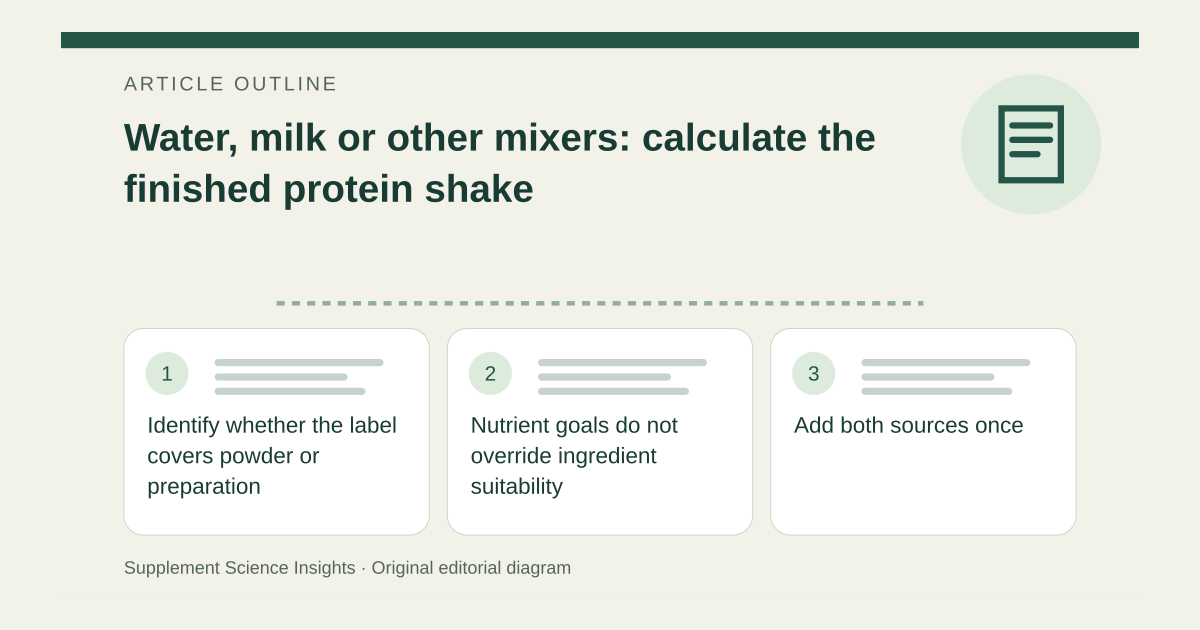
Identify whether the label covers powder or preparation
Read the serving description before adding numbers. If the declaration is for dry powder, include nutrients from the mixer separately. If a label also provides an as-prepared column, check which liquid and volume it assumes. [1][2]
Water does not add a food-protein contribution. Milk and other nutrient-containing mixers can, but their amounts differ by product and portion. The final drink’s composition should reflect what was actually used. [1][2]
Nutrient goals do not override ingredient suitability
Consider allergies, lactose tolerance and other dietary constraints when selecting a mixer. NIDDK distinguishes lactose intolerance from milk-protein allergy; lactose-free dairy does not remove the milk proteins relevant to an allergy. [3]
A thicker or sweeter shake is not automatically more effective for muscle gain. Preparation preferences and a clinical or training outcome are different questions. [3]
Add both sources once
For a practical starting method, use the powder’s preparation directions with water or a suitable milk or alternative, then adjust the liquid for your preferred thickness. There is no universal milliliter amount per scoop because scoop masses and formulations differ. Without a shaker, stir or whisk the powder into a little liquid to form a smooth paste, then gradually add the rest; a blender is another option. For a food-based variation, stir into yogurt or blend with fruit, counting those ingredients separately. These are preparation suggestions, not tested methods for increasing muscle gain. [1]
Imagine the powder supplies 24 g protein and the selected mixer supplies 8 g. The drink provides 32 g, assuming those exact portions. Do not add the mixer again if using an as-prepared label that already includes it. [1]
| Detail | Interpretation |
|---|---|
| Dry-powder amount | One contribution |
| Mixer amount | Additional contribution |
| As-prepared label | Check what is already included |
Sources for this article
- How to Understand and Use the Nutrition Facts Label | FDA
Source consulted: 2026-09-17. This is a reference resource, not a claim that we conducted the studies or tested a product. - Protein in diet: MedlinePlus Medical Encyclopedia
Source consulted: 2026-09-17. This is a reference resource, not a claim that we conducted the studies or tested a product. - Definition & Facts for Lactose Intolerance - NIDDK
Source consulted: 2026-09-17. This is a reference resource, not a claim that we conducted the studies or tested a product.