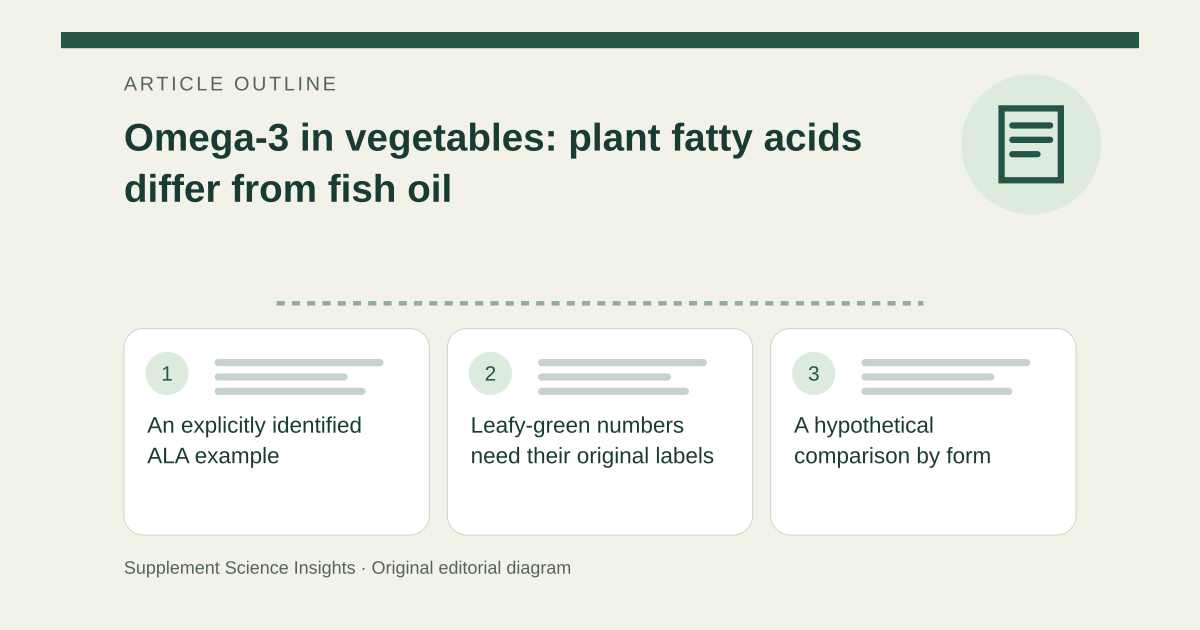
An explicitly identified ALA example
The USDA SR Legacy raw-zucchini entry lists 0.061 g alpha-linolenic acid per 100 g. A 200 g portion provides about 0.122 g. This amount is small compared with concentrated ALA sources such as flaxseed oil, chia seeds and walnuts described by ODS. [1][2]
Leafy-green numbers need their original labels
The older raw-spinach and raw-kale entries list 0.138 and 0.378 g respectively in the undifferentiated 18:3 field per 100 g. That is a fatty-acid class field, not a separately measured EPA-plus-DHA amount or a fully specified ALA result. It is more accurate to retain the field name than to label every such value fish-equivalent omega-3. [1]
A hypothetical comparison by form
Imagine a food log combines ALA from a vegetable with DHA from fish. Keep separate columns for the named forms before considering a total. ODS describes limited conversion of ALA into the longer-chain forms, so the numerical sum alone does not establish equal physiological delivery. These composition records do not show that eating vegetables is equivalent to taking a particular omega-3 supplement. [2]
| Raw zucchini portion | ALA estimate |
|---|---|
| 100 g | 0.061 g |
| 200 g | 0.122 g |
Sources for this article
- USDA FoodData Central — SR Legacy April 2018 composition and portion tables
Source consulted: 2026-09-20. This is a reference resource, not a claim that we conducted the studies or tested a product. - Omega-3 Fatty Acids - Health Professional Fact Sheet
Source consulted: 2026-09-20. This is a reference resource, not a claim that we conducted the studies or tested a product.