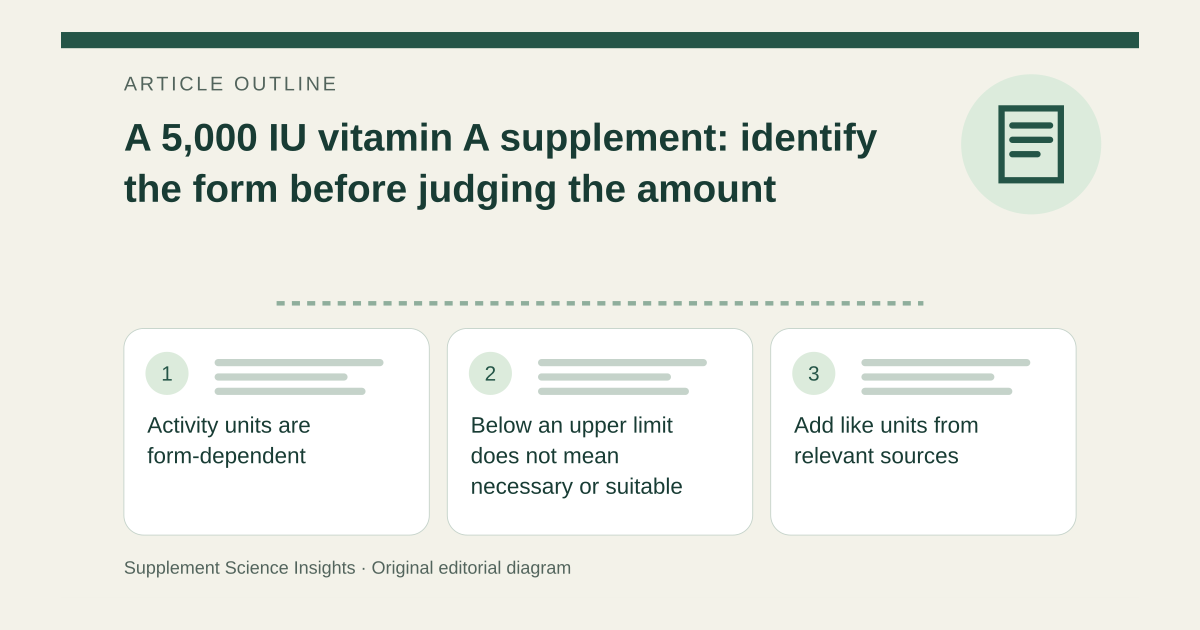
Activity units are form-dependent
ODS gives 1 IU retinol as 0.3 micrograms retinol activity equivalents, or RAE. Multiplying 5,000 by 0.3 gives 1,500 micrograms RAE. The conversion for beta-carotene in food differs from that for retinol, so the ingredient source cannot be omitted. [1]
A mixed formulation also needs its preformed vitamin A portion identified. The upper limit for preformed vitamin A does not apply identically to all carotenoid sources. [1]
Below an upper limit does not mean necessary or suitable
The adult U.S. upper limit for preformed vitamin A is 3,000 micrograms daily from food and supplements. A single product below that amount does not establish the combined intake, and children have lower limits. [1]
Pregnancy, other supplements and concentrated food sources matter. An upper limit is a risk-management reference, not an intake goal or a guarantee of individual safety. Additional beta-carotene also has its own cautions; it is not a universal substitute. [1]
Add like units from relevant sources
Imagine a retinol supplement supplies 1,500 micrograms RAE and another product supplies 900 micrograms preformed vitamin A. Together they supply 2,400 micrograms before food is counted. Looking only at the first bottle would miss that exposure.
| Detail | Meaning |
|---|---|
| 5,000 IU retinol | 1,500 micrograms RAE |
| Adult preformed UL | 3,000 micrograms total daily |
| Mixed forms | Identify the preformed share |
Sources for this article
- NIH ODS: Vitamin A and Carotenoids
Source consulted: 2026-09-17. This is a reference resource, not a claim that we conducted the studies or tested a product.