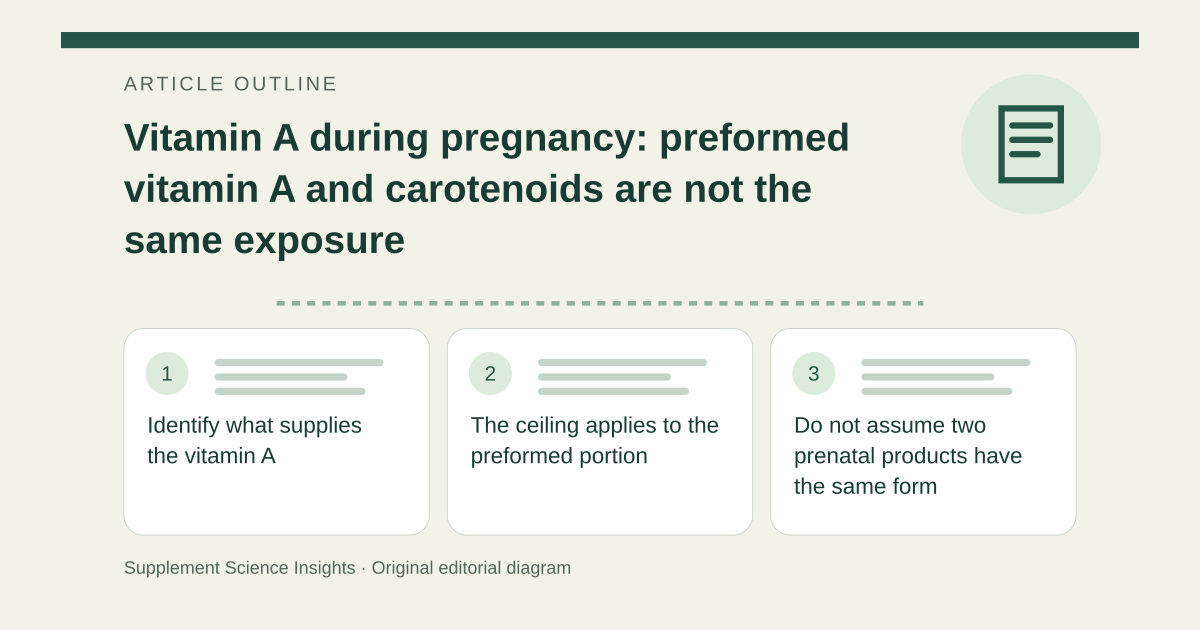
Identify what supplies the vitamin A
Preformed vitamin A includes retinol and retinyl esters such as retinyl palmitate. Provitamin A carotenoids, including beta-carotene, are converted into vitamin A by the body and have a different risk profile. [1]
ODS warns that excessive preformed vitamin A can cause congenital birth defects. It does not identify beta-carotene as having the same reproductive toxicity, but that distinction is not an invitation to take unlimited amounts of any supplement. [1]
The ceiling applies to the preformed portion
For adults, the U.S. upper intake limit for preformed vitamin A is 3,000 micrograms RAE per day from relevant food and supplement sources. At ages 14–18, the limit is 2,800 micrograms RAE, including pregnancy. [1]
These are safety ceilings, not recommended prenatal amounts. A mixed-form supplement may contain both preformed vitamin A and carotenoids, so the total vitamin A line alone may not reveal the preformed portion. [1]
Do not assume two prenatal products have the same form
Imagine two products display the same total vitamin A amount but obtain different proportions from retinyl esters and beta-carotene. Their preformed-vitamin-A exposure is not necessarily identical.
The clinician needs the ingredient sources and amounts as well as other supplements and relevant foods. If the proportions are not declared, the missing information should remain unresolved.
| Observation | Interpretation |
|---|---|
| Total vitamin A | Not always the preformed amount |
| Retinol or retinyl ester portion | Relevant to the preformed upper limit |
| Unknown proportions | Need clarification rather than an invented calculation |
Review the prenatal plan rather than adding a separate high-dose product
Discuss vitamin A supplementation with the maternity clinician, particularly if a separate product is being considered. Retinoid medicines also have their own pregnancy precautions and should not be equated with an ordinary food source. [1]
This page explains the form distinction and upper-limit context. It does not determine a safe personal dose, advise changes to prescribed medicines or replace pregnancy-specific care. [1]
Sources for this article
- NIH ODS — Vitamin A: Health Professional Fact Sheet
Source consulted: 2026-09-17. This is a reference resource, not a claim that we conducted the studies or tested a product.