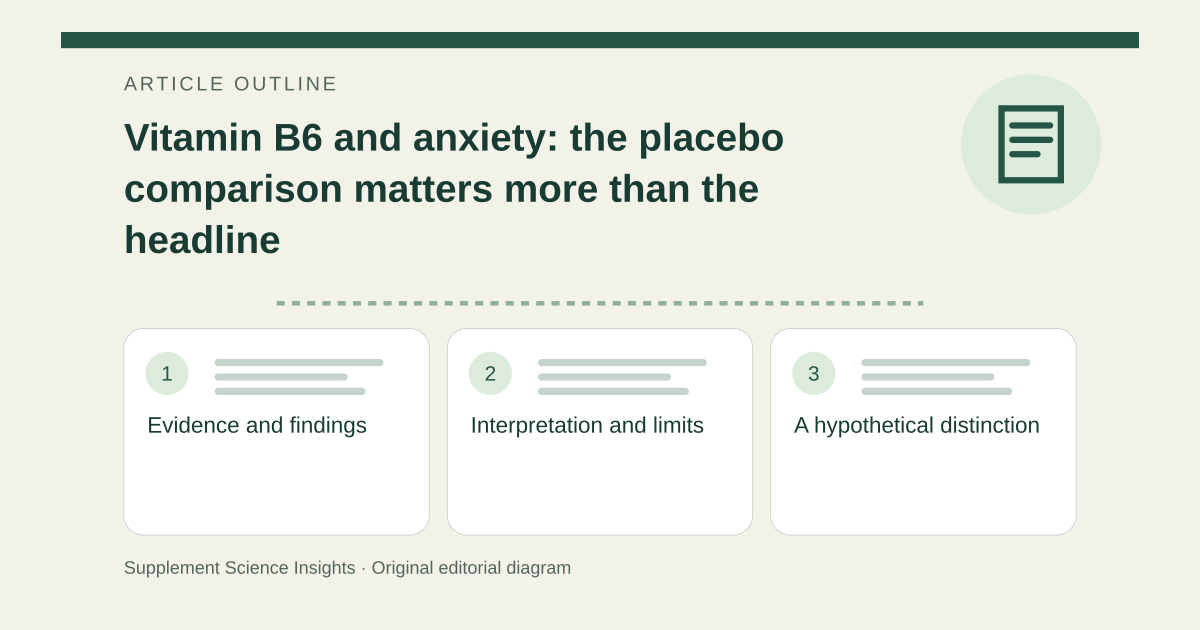
Evidence and findings
The linked study phases recruited 478 young adults, with 265 contributing anxiety assessments. Participants took B6, B12 or placebo for about a month; different subsets completed sensory and mood measures. [1]
Anxiety decreased in the B6 group. However, the B6-versus-placebo interaction had a p-value of 0.140, so the analysis did not establish a reliable difference in change between those groups. [1]
Interpretation and limits
The study used 100 milligrams of B6 daily, a research exposure rather than a recommendation. Innopure donated tablets; authors declared no conflicts. Multiple outcomes, varying samples and the short duration limit inference, and sensory-test findings are not direct measurements of brain GABA. [1]
A hypothetical distinction
Imagine one group improves significantly and another does not. That contrast in significance is not itself a significant contrast between treatments.
| Detail | Interpretation |
|---|---|
| Within-group result | Starting-to-ending change |
| Interaction test | Compared changes |
| Research dose | Not personal advice |
Sources for this article
- High‐dose Vitamin B6 supplementation reduces anxiety and strengthens visual surround suppression - PMC
Source consulted: 2026-09-19. This is a reference resource, not a claim that we conducted the studies or tested a product.