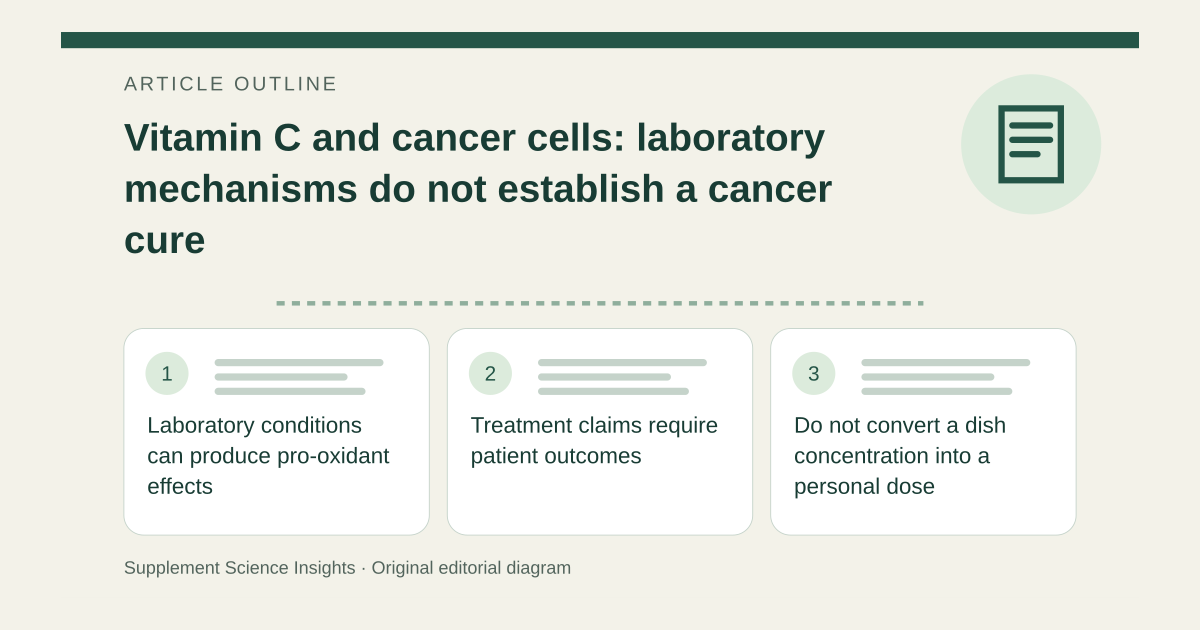
Laboratory conditions can produce pro-oxidant effects
The National Cancer Institute describes experiments in which pharmacological ascorbate contributes to hydrogen peroxide generation and cancer-cell injury. Other experiments involve iron handling, metabolic pathways or differences between cell types. [1]
These findings are not equivalent to the normal nutritional role of vitamin C. The concentration, chemical form and experimental setting matter, and oral supplements cannot simply be assumed to reproduce an intravenous exposure. [1]
Treatment claims require patient outcomes
NCI reviews clinical research as well as laboratory work, but the FDA has not approved high-dose vitamin C as a cancer treatment. A cell-culture result cannot identify a curative dose for a person. [1]
NCI also describes kidney-related risks, hemolysis concerns in G-6-PD deficiency and possible interactions with cancer therapies. This is an authoritative evidence summary rather than an independently appraised trial. People receiving cancer treatment should review proposed infusions or concentrated supplements with their oncology team. [1]
Do not convert a dish concentration into a personal dose
Imagine a substance kills cells at a laboratory concentration. Determining whether that exposure is achievable, selective and beneficial in a person requires separate clinical investigation.
| Detail | Interpretation |
|---|---|
| Cancer-cell experiment | Mechanistic evidence |
| Patient benefit | Requires clinical outcomes |
| High-dose treatment | Not FDA-approved for cancer |
Sources for this article
- Intravenous Vitamin C (PDQ®) - NCI
Source consulted: 2026-09-19. This is a reference resource, not a claim that we conducted the studies or tested a product.