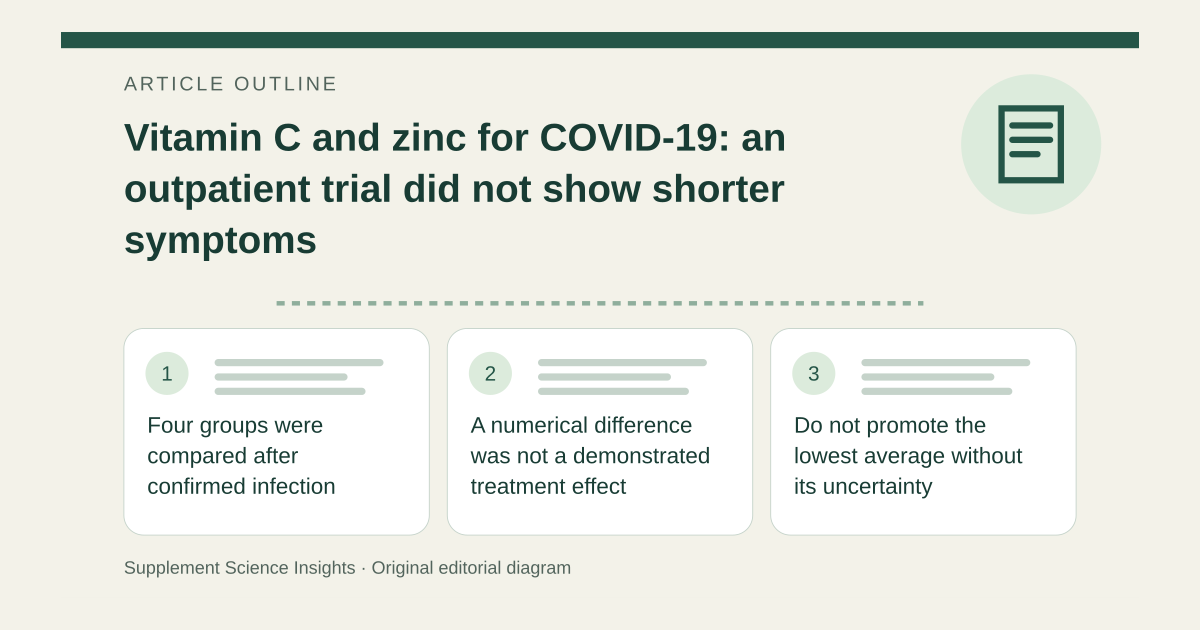
Four groups were compared after confirmed infection
The trial randomized 214 adults with confirmed SARS-CoV-2 infection to vitamin C, zinc, both supplements or usual care. Treatment lasted ten days, and the primary endpoint was time to a 50% reduction in symptom severity. [1]
There was no statistically significant difference among groups for that endpoint or the reported secondary outcomes. The trial stopped early because the likelihood of demonstrating benefit was low. [1]
A numerical difference was not a demonstrated treatment effect
The study was open-label and took place in 2020, before later variants and treatment settings. Its results do not establish prevention, a safe megadose for every person or equivalence to current antiviral care. [1]
Some investigators disclosed outside pharmaceutical consulting or research relationships; funding was not fully established from the abstract. The tested high amounts should not be copied as a personal regimen. This trial supports avoiding claims that the supplements reliably shorten outpatient COVID symptoms. [1]
Do not promote the lowest average without its uncertainty
Imagine one group’s average recovery time is numerically shorter but the comparison is not significant. The result does not establish that the supplement caused faster recovery.
| Detail | Interpretation |
|---|---|
| 214 outpatients | Treatment population |
| Four-group comparison | No significant symptom-duration benefit |
| Infection prevention | Not tested |
Sources for this article
- Effect of High-Dose Zinc and Ascorbic Acid Supplementation vs Usual Care on Symptom Length and Reduction Among Ambulatory Patients With SARS-CoV-2 Infection: The COVID A to Z Randomized Clinical Trial - PubMed
Source consulted: 2026-09-19. This is a reference resource, not a claim that we conducted the studies or tested a product.