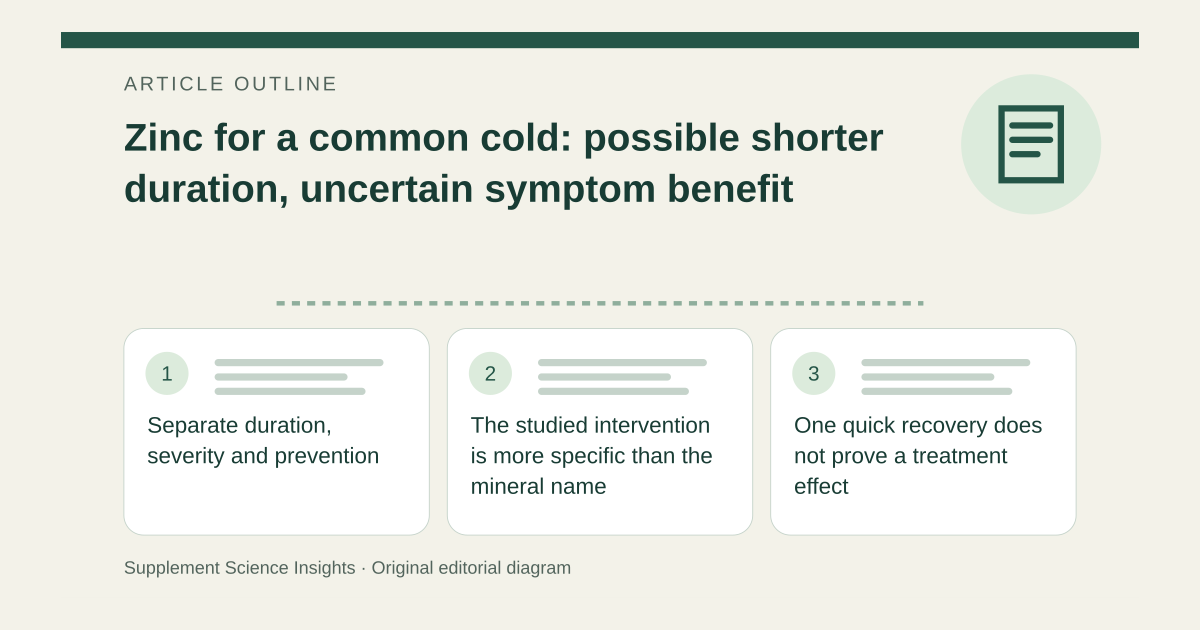
Separate duration, severity and prevention
ODS reports that a 2024 Cochrane review found zinc may reduce the duration of an existing cold, while making little or no difference to preventing colds. Whether it reduces symptom severity remains unclear. The fact sheet describes the certainty of these conclusions as low to very low. [1]
A shorter illness is different from immediate relief, milder symptoms or fewer future infections. Someone should not expect all of those outcomes merely because a headline says zinc “works for colds.” This page summarizes ODS’s account; it is not an independent reanalysis of the trials. [1]
The studied intervention is more specific than the mineral name
Many cold studies used oral lozenges, and some used syrup, started early in the illness. Results have varied between studies. A routine swallowed multivitamin should not be assumed to reproduce a lozenge regimen simply because both list zinc. [1]
The preparation, total amount, timing and participants affect the relevance of a result. Evidence from oral use also does not establish that a nasal product is interchangeable. This article provides no nasal-use recommendation or dosing protocol. [1]
One quick recovery does not prove a treatment effect
Imagine someone starts a lozenge on the day their cold begins to improve and feels well soon afterward. That sequence does not reveal how long the illness would have lasted without the product.
Controlled comparisons are needed to separate treatment effects from the natural course of an illness. Even their average findings cannot promise a particular recovery time for one person.
| Question | What it establishes |
|---|---|
| Shorter duration | Different from instant symptom relief |
| Lozenge evidence | Not proof for every zinc-containing product |
| One personal recovery | Cannot show the untreated comparison |
Consider the total exposure and tolerability
Zinc can cause nausea and stomach distress and can interact with certain antibiotics and penicillamine. Repeated lozenges also contribute to total intake alongside multivitamins or separate supplements. [1]
The adult upper intake limit of 40 mg per day is a general nutrition safety ceiling, not a cold-treatment recipe. Trial doses should not be copied without considering medical guidance. The uncertainty in the evidence is a reason to weigh possible benefit against adverse effects, not to keep increasing the amount until symptoms change. [1]
Sources for this article
- NIH ODS — Zinc: Health Professional Fact Sheet
Source consulted: 2026-09-17. This is a reference resource, not a claim that we conducted the studies or tested a product.