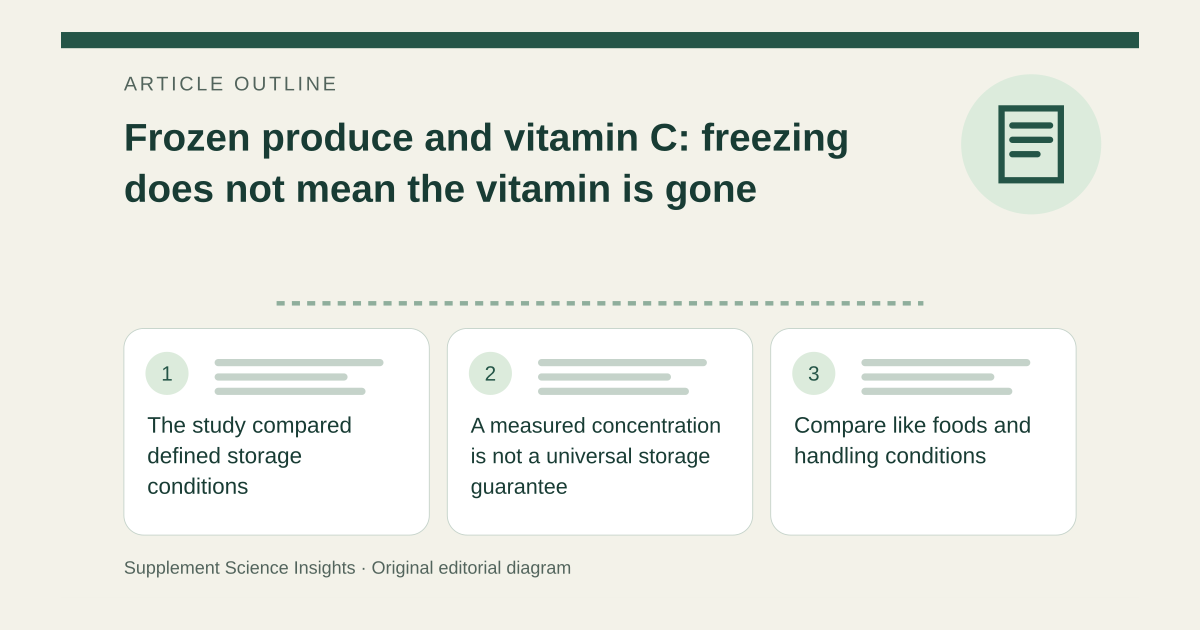
The study compared defined storage conditions
Researchers analyzed corn, carrots, broccoli, spinach, peas, green beans, strawberries and blueberries. Samples were harvested, processed and measured at three storage times for each treatment. [1]
For vitamin C, five commodities showed no significant fresh-versus-frozen difference; frozen samples had higher measured levels for the other three. The experiment therefore does not support a blanket claim that freezing destroys vitamin C. [1]
A measured concentration is not a universal storage guarantee
The findings apply to the studied products and handling conditions. They do not establish indefinite nutrient retention, identical results for every fruit or the effect of every thawing and cooking method. [1]
Other vitamins did not always follow the same pattern. Funding and conflicts were not established from the abstract. The practical interpretation is that frozen produce can retain vitamin C; the word fresh alone does not reveal how long a food has been stored or its current measured content. [1]
Compare like foods and handling conditions
Imagine freshly harvested produce is compared with produce stored for several days. Storage history is part of the comparison, so a difference cannot be attributed to the label word alone.
| Detail | Interpretation |
|---|---|
| Eight commodities | Defined sample types |
| Five vitamin C comparisons | No significant difference |
| Three comparisons | Higher in frozen samples |
Sources for this article
- Vitamin retention in eight fruits and vegetables: a comparison of refrigerated and frozen storage - PubMed
Source consulted: 2026-09-19. This is a reference resource, not a claim that we conducted the studies or tested a product.