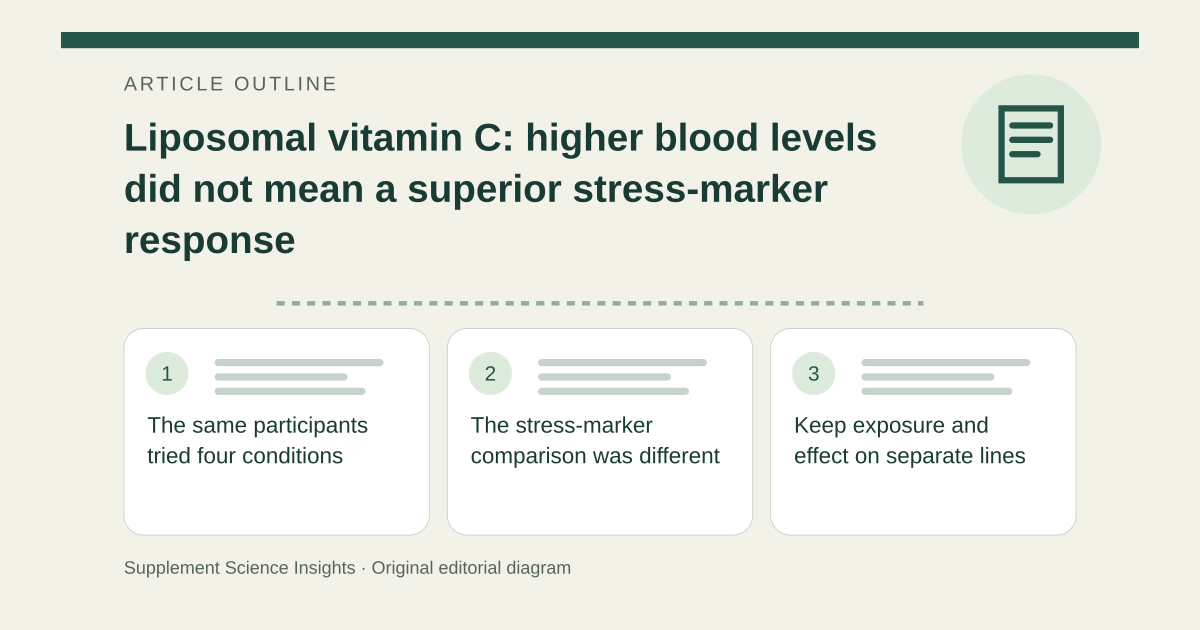
The same participants tried four conditions
Eleven men and women received placebo, ordinary oral vitamin C, liposomal oral vitamin C and intravenous vitamin C on separate occasions in randomized order. Each active condition used the same vitamin C amount. [1]
Blood concentrations were higher with the liposomal oral preparation than with ordinary oral delivery, but lower than with intravenous delivery. These findings describe exposure to the tested preparations. [1]
The stress-marker comparison was different
Researchers temporarily restricted forearm blood flow with a cuff and assessed an oxidative-stress response after release. Protection on that endpoint was similar across the active delivery approaches. [1]
This small, acute experiment cannot establish fewer illnesses, longer-term health benefits or equivalence of every liposomal product. Funding and conflicts were not fully assessed from the abstract; an author had commercial laboratory affiliations. Greater blood exposure should not be presented as proof that paying more for a formulation improves clinical outcomes. [1]
Keep exposure and effect on separate lines
Imagine formulation A produces higher blood levels than B but both have similar measured effects. The exposure difference alone does not prove a superior outcome.
| Detail | Interpretation |
|---|---|
| Plasma exposure | Higher than ordinary oral delivery |
| Stress-marker response | Similar among active treatments |
| Long-term illness outcomes | Not tested |
Sources for this article
- Liposomal-encapsulated Ascorbic Acid: Influence on Vitamin C Bioavailability and Capacity to Protect Against Ischemia-Reperfusion Injury - PubMed
Source consulted: 2026-09-19. This is a reference resource, not a claim that we conducted the studies or tested a product.