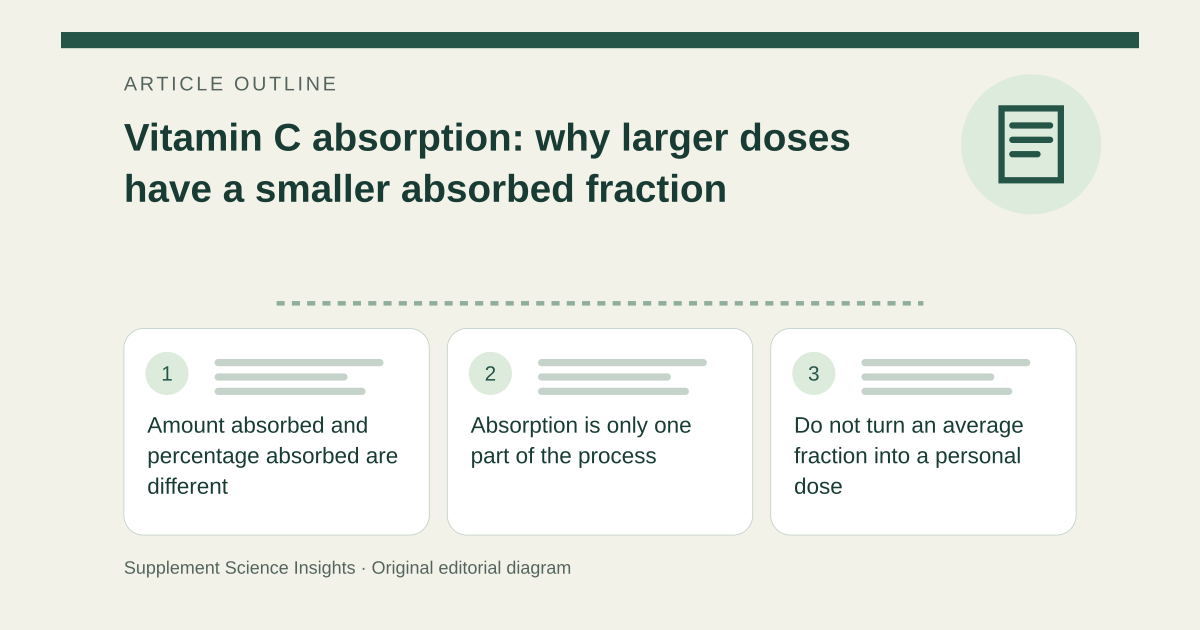
Amount absorbed and percentage absorbed are different
ODS reports that roughly 70–90% of vitamin C is absorbed at moderate intakes of 30–180 mg per day, while the absorbed fraction falls below 50% at doses above 1 gram per day. These are general pharmacokinetic observations, not a way to calculate exact absorption for an individual. [1]
A smaller percentage does not necessarily mean a smaller absolute amount. It means that a larger share of the swallowed dose is not absorbed. The relationship is not a simple straight line in which twice the dose produces twice the effect. [1]
Absorption is only one part of the process
The body tightly regulates tissue and plasma vitamin C concentrations. Absorbed vitamin C that remains unmetabolized can be excreted in urine. Swallowed, absorbed, circulating and retained quantities therefore describe different stages. [1]
A rise in a blood concentration is not automatically evidence of better wound healing or fewer infections. Those are clinical outcomes requiring their own evidence, even when an absorption claim is accurate. [1]
Do not turn an average fraction into a personal dose
Imagine two people take different amounts and use a published average absorption percentage to predict their exact blood results. Their arithmetic omits regulation, excretion and differences in the circumstances of the measurement.
The source values explain why dose and exposure are not proportional. They do not establish the ideal schedule or prove that a particular retail formulation outperforms another.
| Detail | Meaning |
|---|---|
| Swallowed amount | The label quantity actually used |
| Absorbed fraction | Percentage crossing the intestine |
| Blood concentration | Also reflects regulation and elimination |
Unabsorbed vitamin C can have effects too
High amounts remaining in the intestine can have an osmotic effect and contribute to diarrhea, nausea or abdominal cramps. Thus, a large unabsorbed fraction is not necessarily harmless simply because it fails to reach the circulation. [1]
Do not use an absorption estimate to justify repeatedly increasing intake. The adult upper limit and individual conditions still apply; kidney disease and iron-overload disorders can make a generic high-dose approach inappropriate. [1]
Sources for this article
- NIH ODS — Vitamin C: Health Professional Fact Sheet
Source consulted: 2026-09-17. This is a reference resource, not a claim that we conducted the studies or tested a product.