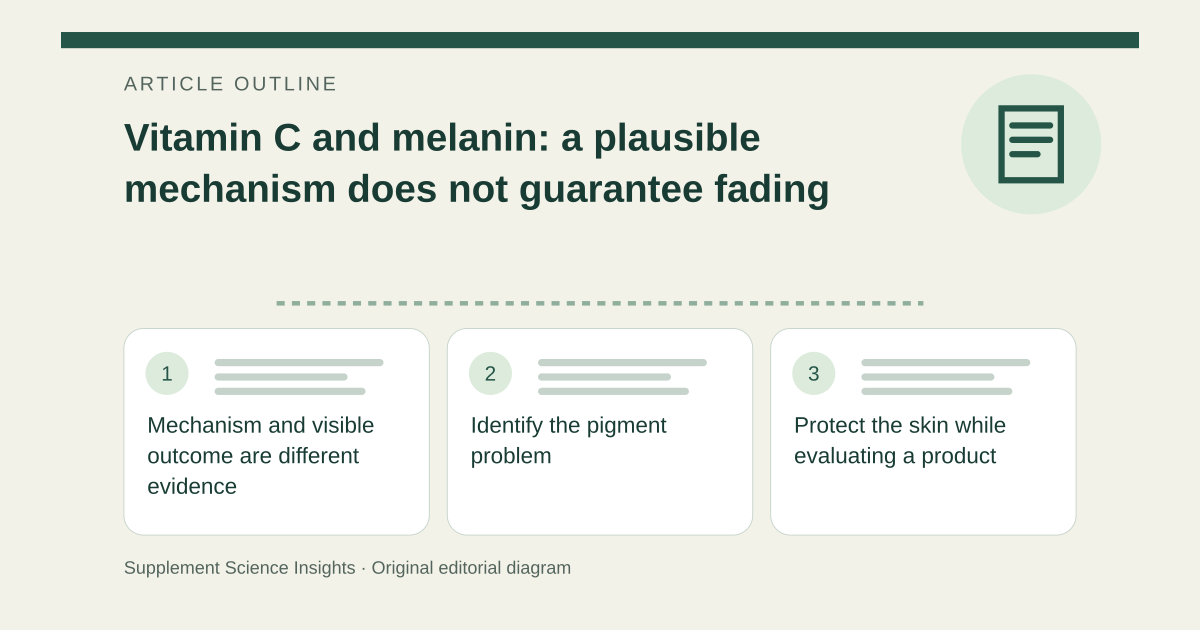
Mechanism and visible outcome are different evidence
The skin-health review describes effects on melanogenesis and reactions involving tyrosinase and pigment intermediates. Laboratory activity supports a rationale for research; it does not tell an individual how much a dark spot will fade or how quickly a retail serum will work. [1]
Identify the pigment problem
Melasma, marks after inflammation and other pigmentation changes are not one interchangeable condition. The vitamin C reviews discuss limited studies of particular formulations, sometimes with delivery-enhancing ingredients. Their findings should not be transferred to an oral capsule rubbed onto skin or to every derivative at the same percentage. [2][1]
Protect the skin while evaluating a product
Imagine a new serum causes irritation while being used for dark marks. Continuing because tingling seems like pigment removal is not a sound test of benefit. Stop a reacting product, maintain sun protection and ask a dermatologist about persistent or changing pigmentation rather than escalating concentration indefinitely. [3][4]
| Question | Practical interpretation |
|---|---|
| Pigment-related mechanism | Reason for study |
| A specific clinical formula | Not every retail serum |
| Irritation | Not proof of pigment removal |
Sources for this article
- The Roles of Vitamin C in Skin Health - PMC
Source consulted: 2026-09-20. This is a reference resource, not a claim that we conducted the studies or tested a product. - Topical Vitamin C and the Skin: Mechanisms of Action and Clinical Applications - PMC
Source consulted: 2026-09-20. This is a reference resource, not a claim that we conducted the studies or tested a product. - How to test skin care products
Source consulted: 2026-09-20. This is a reference resource, not a claim that we conducted the studies or tested a product. - Dermatologist-recommended skin care for your 20s
Source consulted: 2026-09-20. This is a reference resource, not a claim that we conducted the studies or tested a product.