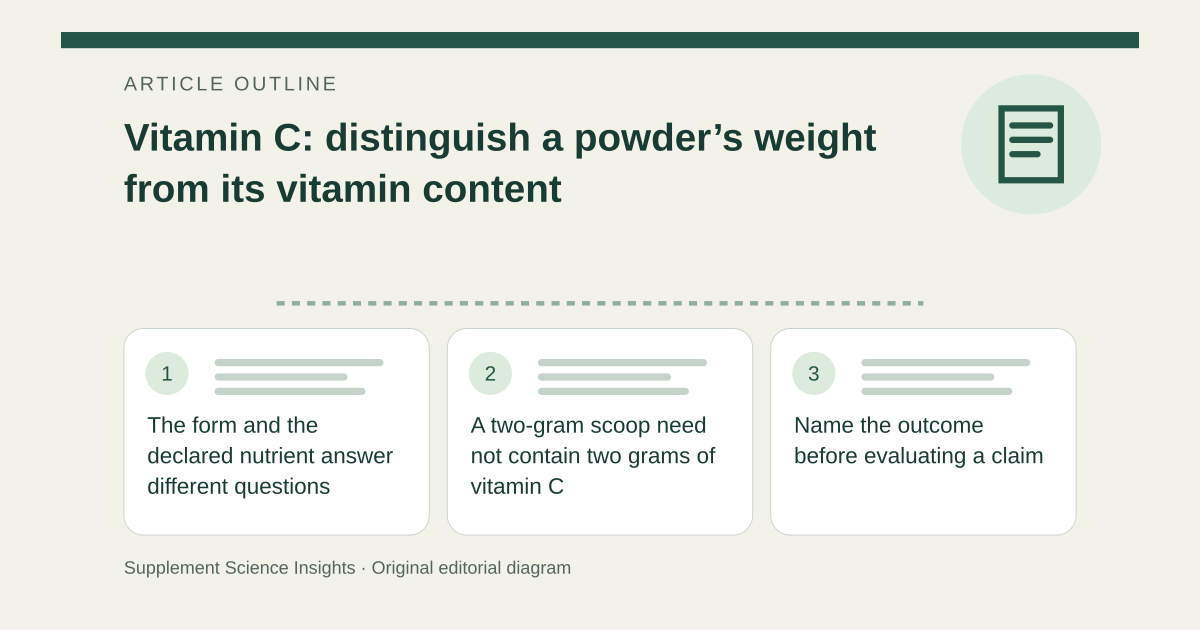
The form and the declared nutrient answer different questions
Vitamin C supplements include ascorbic acid and forms such as sodium or calcium ascorbate. NIH ODS states that research has not shown one supplemental form to be better than the others. A form name therefore should not be treated as proof of superior clinical results. [1]
Copy the vitamin C amount from its labeled entry and preserve the serving size and ingredient list. If a product name emphasizes a mineral ascorbate, record any separately declared mineral amount as its own entry rather than guessing it from the name. [1]
A two-gram scoop need not contain two grams of vitamin C
An invented powder has a 2 g serving and declares 250 mg vitamin C per serving. Converting the total powder weight gives 2,000 mg. That describes all of the powder, while the vitamin C declaration remains 250 mg.
The remaining mass cannot be identified from these two entries alone. It is not evidence of a defect or a reason to assume a particular filler. The example is label arithmetic, not a recommended serving or a verified retail formulation.
| Field | Recorded quantity |
|---|---|
| Total powder per serving | 2 g = 2,000 mg |
| Vitamin C per serving | 250 mg |
| Other material | Identity not established by these two entries |
| Absorbed vitamin C | Not established |
Name the outcome before evaluating a claim
An antioxidant description, a laboratory result and a claim about preventing illness are different statements. Write down exactly which statement an advertisement makes, then identify the study outcome used to support it.
Keep the studied preparation, route, participants and comparison group attached to that outcome. Evidence involving an intravenous intervention cannot be treated as a direct test of a retail powder. This page does not recommend either intervention or predict a clinical effect.
Include medical treatment in the supplement discussion
Excess vitamin C can cause diarrhea, nausea and abdominal cramps. High doses can worsen iron overload in people with hereditary hemochromatosis. People receiving cancer treatment should ask their oncologist before using vitamin C or other antioxidant supplements because interactions are possible. [1]
Do not treat a water-soluble vitamin as automatically suitable at any amount. Bring the exact product and all other supplements to the discussion. This page supplies no high-dose regimen and does not advise replacing medical treatment. [1]
Keep the scoop, serving and nutrient fields separate
A practical record has distinct fields for total serving mass, declared vitamin C, named form, other ingredients and directions. Keep the label photograph with the entry so the quantities can be checked without relying on a product title.
If a scoop size or serving declaration is missing, do not fill it in from another flavor. Record the missing field and ask for the exact package label. An estimate that looks precise can still describe the wrong formulation.
Finish with the narrow result the label supports
For the invented example, an accurate note is: “A 2 g powder serving declares 250 mg vitamin C.” It does not establish absorbed amount, purity, symptom improvement or whether someone should take the product.
The government resource supports the cited background and safety context. This article is not a new systematic review of vitamin C outcomes, a product endorsement or an independent medical approval. Those assessments remain separate.
Sources for this article
- NIH ODS — Vitamin C: Consumer Fact Sheet
Source consulted: 2026-09-17. This is a reference resource, not a claim that we conducted the studies or tested a product.
Considering a supplement?
Ingredient evidence alone does not establish which retail product is suitable. The featured option illustrates the label and formulation context above; it is not a clinical efficacy ranking.
Compare vitamin c formulations (retail checks pending) → No overall winner
Compare formulations → · How we select products