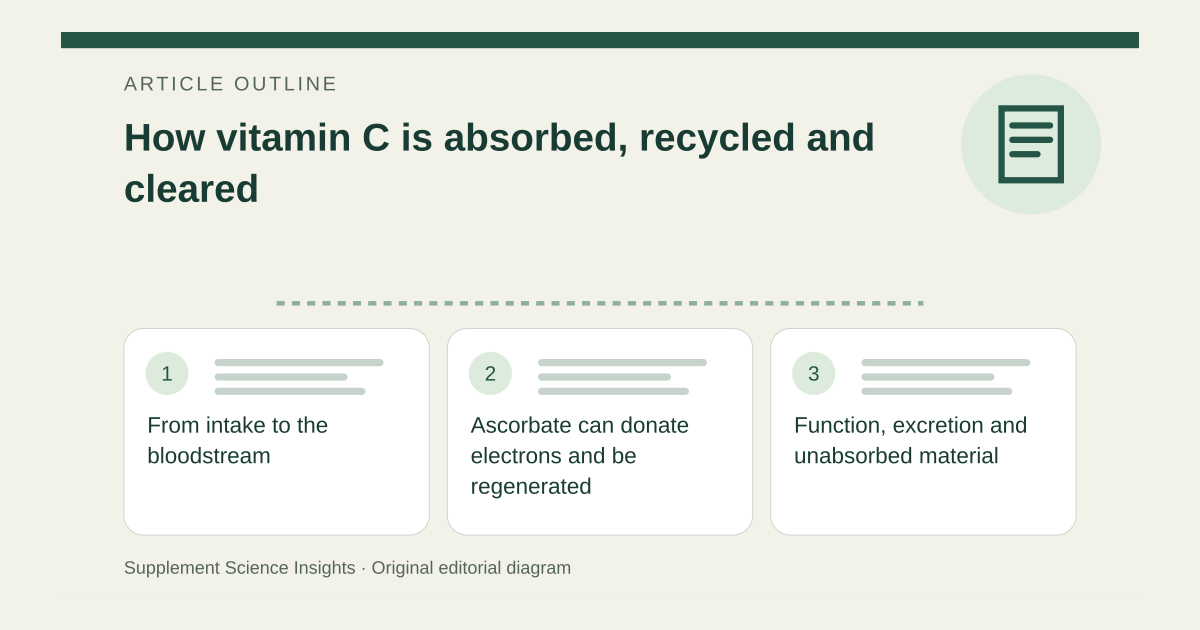
From intake to the bloodstream
Vitamin C enters the body through food or supplements and is absorbed from the intestine. Humans need a dietary supply because they cannot complete the pathway that makes vitamin C from glucose. Once absorbed, vitamin C is distributed to tissues, used in chemical reactions, recycled and eventually cleared or broken down. [1][2]
The amount swallowed is not the same as the amount absorbed. NIH reports that the fraction absorbed falls as oral intake becomes large. Plasma concentrations are also regulated. Consequently, multiplying an oral dose does not multiply the blood concentration by the same factor. [1][2]
Ascorbate can donate electrons and be regenerated
Ascorbic acid and its oxidized form, dehydroascorbic acid, both have vitamin C activity. Ascorbate donates electrons in reactions involving antioxidant protection and enzyme function. Oxidation can produce an intermediate radical and then dehydroascorbic acid; these forms can be reduced back to ascorbate in the body. [2]
This recycling helps distinguish using a vitamin from immediately destroying every molecule. Some oxidized vitamin C is regenerated, while some proceeds to irreversible breakdown. The National Academies’ description includes irreversible hydrolysis of dehydroascorbic acid to diketogulonic acid. The balance is more complex than “all vitamin C is used once” or “all excess simply stays available.” [2]
Function, excretion and unabsorbed material
Vitamin C supports enzymes involved in making collagen and several other biological molecules. These normal functions explain why deficiency matters, but they do not establish that a large supplemental intake enhances every function beyond normal. Adequate availability and a demonstrated treatment effect are different questions. [1][2]
Absorbed, unmetabolized vitamin C can be excreted in urine. Material that is not absorbed remains in the intestinal tract, where high intakes can contribute to gastrointestinal symptoms. Thus urinary clearance does not mean that unlimited oral intake is harmless: the intestine is exposed before the kidneys can clear absorbed material. [1][2]
Why a tenfold dose is not tenfold exposure
Imagine comparing two oral products that provide 100 mg and 1,000 mg per serving. The second contains ten times as much vitamin C, but that calculation describes the contents only. Absorption, tissue uptake and excretion prevent it from being a valid calculation of a tenfold blood level or tenfold clinical benefit. Use the label to calculate intake, and use appropriate human evidence to evaluate an outcome. [1]
| Comparison | What can be concluded |
|---|---|
| 1,000 mg versus 100 mg swallowed | Tenfold difference in the declared intake |
| Blood concentration | Cannot be calculated by multiplying the dose ratio |
| Clinical benefit | Requires evidence for the actual outcome |
Sources for this article
- Vitamin C - Health Professional Fact Sheet
Source consulted: 2026-09-20. This is a reference resource, not a claim that we conducted the studies or tested a product. - Vitamin C - Dietary Reference Intakes for Vitamin C, Vitamin E, Selenium, and Carotenoids - NCBI BookshelfTwitterFacebookLinkedInGitHubNCBI Insights BlogTwitterFacebookYoutube
Source consulted: 2026-09-20. This is a reference resource, not a claim that we conducted the studies or tested a product.