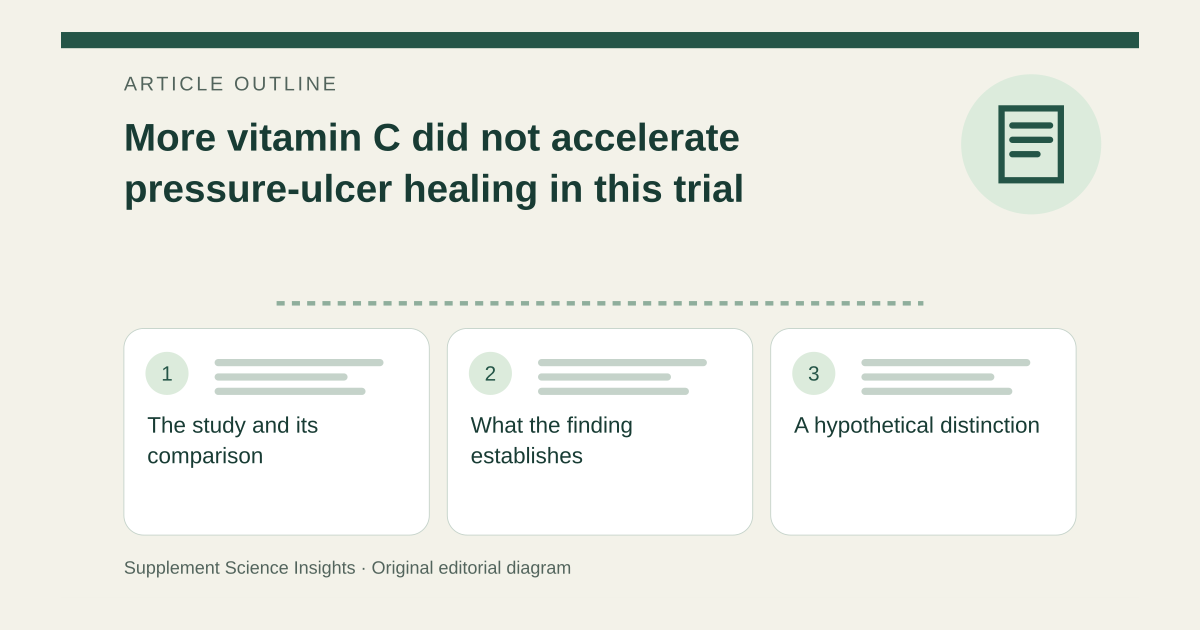
The study and its comparison
Eighty-eight patients from nursing homes and a hospital were randomized in a blinded trial. The higher-dose group received 500 milligrams twice daily; controls received ten milligrams twice daily. [1]
Over twelve weeks, wound closure was not faster with the higher amount. Surface healing rates and other wound assessments also did not favor it. [1]
What the finding establishes
This was not a comparison with absolutely no vitamin C, and it does not settle treatment of severe deficiency. Pressure ulcers also differ from other wound types. Funding and conflicts were not established from the abstract. The finding does not negate vitamin C’s normal nutritional role; it challenges a claim that a larger amount necessarily speeds clinical healing. [1]
A hypothetical distinction
Imagine both groups receive some vitamin C and the larger amount adds no benefit. That does not show the nutrient is unnecessary.
| Detail | Interpretation |
|---|---|
| Measured outcome | Keep the endpoint specific |
| Study preparation | Not every retail product |
| Remaining uncertainty | Not resolved by a mechanism |
Sources for this article
- Randomized clinical trial of ascorbic acid in the treatment of pressure ulcers.
Source consulted: 2026-09-19. This is a reference resource, not a claim that we conducted the studies or tested a product.