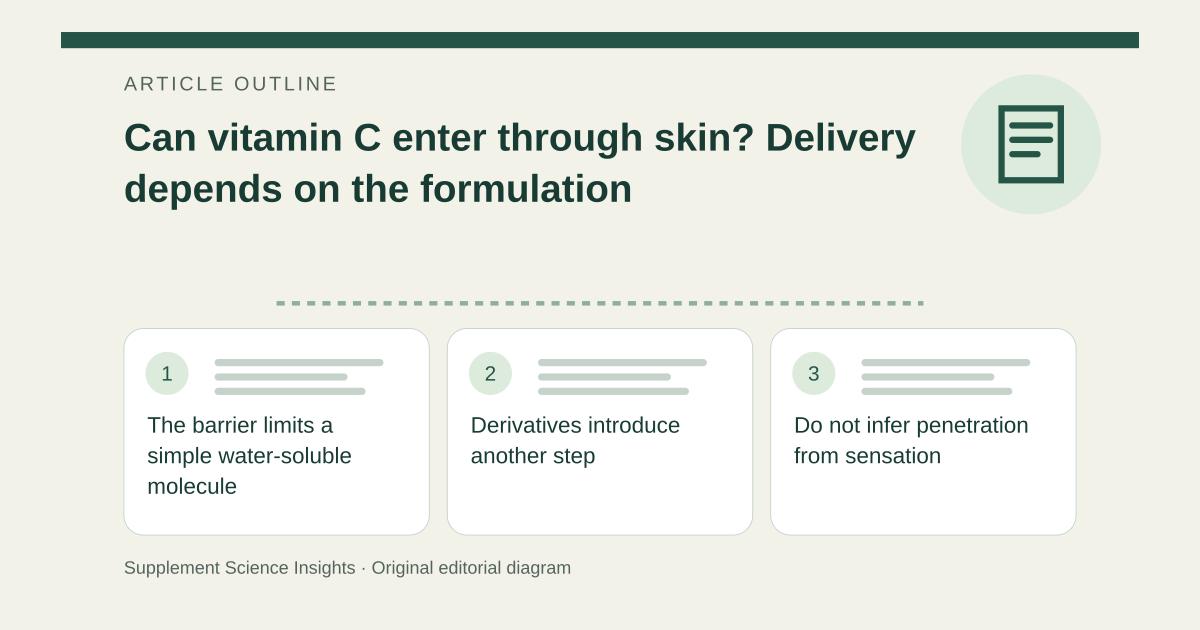
The barrier limits a simple water-soluble molecule
L-ascorbic acid is water-soluble, while the outer skin barrier restricts its passage. Formulation characteristics, including acidity and vehicle, influence delivery. A powder dissolved in water is therefore not automatically equivalent to a tested topical preparation, even if the nominal vitamin amount matches. [1]
Derivatives introduce another step
Modified vitamin C compounds may improve particular stability or delivery properties, but conversion to active ascorbic acid and performance can differ. The skin-health review describes uncertainty across derivatives. A more stable bottle and a better clinical skin outcome are related questions that still require separate evidence. [2]
Do not infer penetration from sensation
Imagine a serum stings and another does not. That difference cannot quantify how much vitamin C reached a skin layer. Nor does topical use establish that an oral nutritional requirement has been met. Evaluate the formulation and intended local outcome, and stop a product that provokes a significant reaction. [3][2]
| Example | Interpretation |
|---|---|
| Applied to skin | Not a measured absorbed amount |
| Stable derivative | Conversion and delivery still matter |
| Stinging | Not an absorption test |
Sources for this article
- Topical Vitamin C and the Skin: Mechanisms of Action and Clinical Applications - PMC
Source consulted: 2026-09-20. This is a reference resource, not a claim that we conducted the studies or tested a product. - The Roles of Vitamin C in Skin Health - PMC
Source consulted: 2026-09-20. This is a reference resource, not a claim that we conducted the studies or tested a product. - How to test skin care products
Source consulted: 2026-09-20. This is a reference resource, not a claim that we conducted the studies or tested a product.