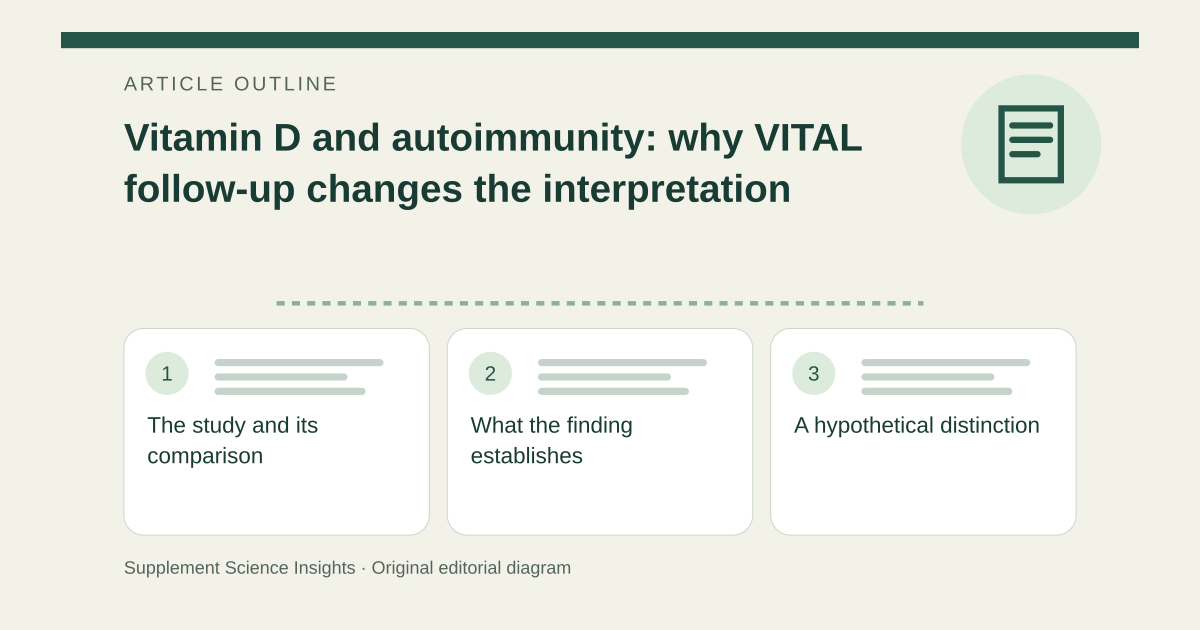
The study and its comparison
VITAL randomized 25,871 older adults to vitamin D or placebo and, independently, omega-3 or placebo. The original median 5.3-year analysis reported fewer confirmed autoimmune diseases with vitamin D. [1][2]
Follow-up included 21,592 participants for two further years. Newly confirmed cases with onset during the trial changed the randomized-period vitamin D estimate: its confidence interval now included no difference. At seven years, vitamin D groups had 255 versus 259 confirmed cases. [1][2]
What the finding establishes
The first estimate should not stand alone as proof of prevention. Later ascertainment and stopping the randomized intervention complicate comparison across periods. Funding and complete conflicts were not established from the retrieved abstracts. These results do not test treatment of an existing autoimmune disease. [1][2]
A hypothetical distinction
Imagine delayed confirmation adds events to an earlier period. The updated analysis deserves attention even when the original headline was favorable.
| Detail | Interpretation |
|---|---|
| Measured outcome | Keep the endpoint specific |
| Study preparation | Not every retail product |
| Remaining uncertainty | Not resolved by a mechanism |
Sources for this article
- Vitamin D and marine omega 3 fatty acid supplementation and incident autoimmune disease: VITAL randomized controlled trial.
Source consulted: 2026-09-19. This is a reference resource, not a claim that we conducted the studies or tested a product. - Vitamin D and Marine n-3 Fatty Acids for Autoimmune Disease Prevention: Outcomes Two Years After Completion of a Double-Blind, Placebo-Controlled Trial.
Source consulted: 2026-09-19. This is a reference resource, not a claim that we conducted the studies or tested a product.