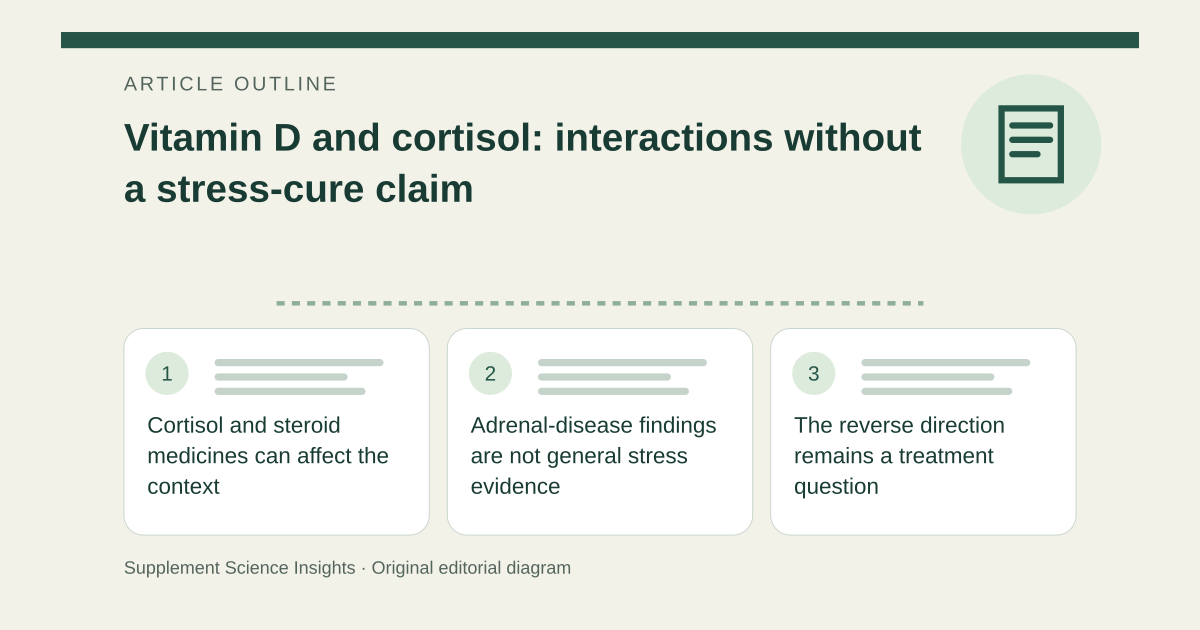
Cortisol and steroid medicines can affect the context
A 2022 systematic review describes links between glucocorticoid excess, vitamin D metabolism and skeletal health. NIH also notes that corticosteroid medicines can impair vitamin D metabolism and calcium absorption. Prescribed steroid treatment and ordinary day-to-day stress are not interchangeable exposures. [1][2]
Adrenal-disease findings are not general stress evidence
The review reports lower vitamin D levels in some studies of Cushing disease and associations with cortisol measures. The studies were relatively scarce and heterogeneous. Such observations cannot establish whether vitamin D is a cause, consequence or accompanying feature of the disease in every patient. [1]
The reverse direction remains a treatment question
Vitamin D receptors and related pathways provide a rationale for studying adrenal function. However, the review explicitly concludes that evidence is insufficient for firm diagnostic and therapeutic conclusions. Taking vitamin D has not thereby become an established way to normalize cortisol or treat an adrenal disorder. [1]
Keep nutritional care and endocrine care distinct
A patient taking long-term glucocorticoids may need attention to bone health and vitamin D status. That does not justify stopping the medicine or adding large doses without a plan. Excess vitamin D can cause hypercalcemia and kidney problems, while the underlying endocrine or inflammatory condition still needs its own management. [2][1]
Avoid diagnosing from two labels
Imagine someone with fatigue sees a low vitamin D result and assumes high cortisol is the cause. The result does not establish that diagnosis or a cortisol-lowering dose. Review symptoms, medicines and the reason for testing with a clinician while addressing the nutritional finding appropriately. [2][1]
| Finding | Appropriate interpretation |
|---|---|
| Long-term steroid medicine | Review nutritional and bone-health needs |
| Low D in adrenal-disease studies | Association has limited causal meaning |
| Vitamin D receptor signaling | Research rationale, not a cure |
| Fatigue plus low vitamin D | Does not diagnose abnormal cortisol |
Sources for this article
- Vitamin D and adrenal gland: Myth or reality? A systematic review - PMC
Source consulted: 2026-09-21. This is a reference resource, not a claim that we conducted the studies or tested a product. - Vitamin D - Health Professional Fact Sheet
Source consulted: 2026-09-21. This is a reference resource, not a claim that we conducted the studies or tested a product.