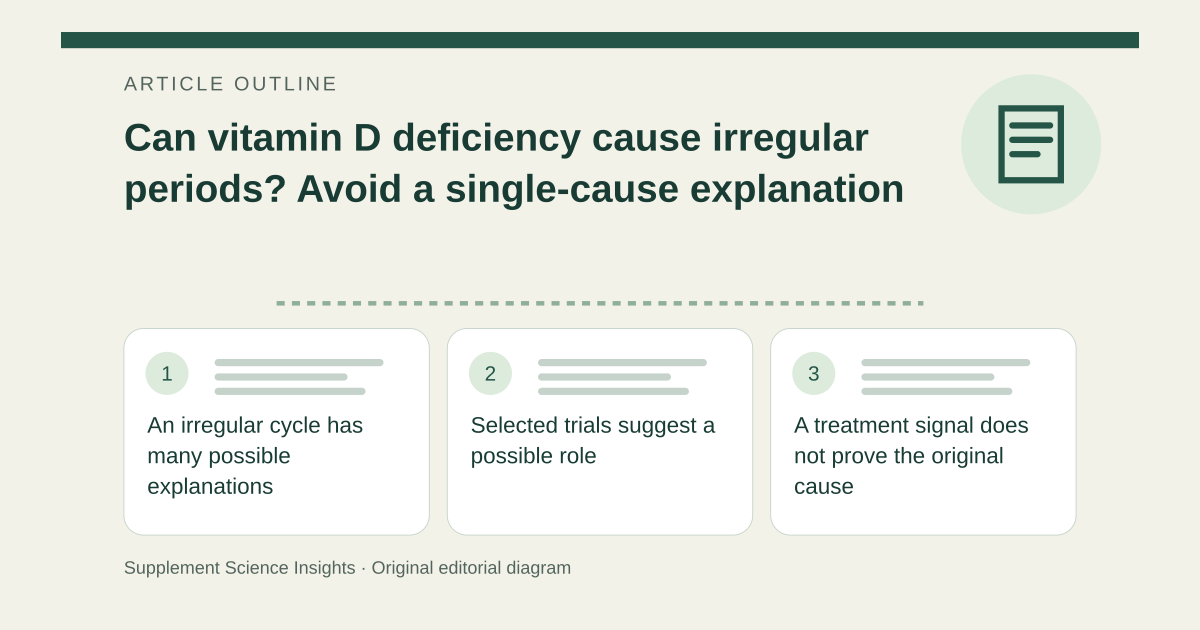
An irregular cycle has many possible explanations
NHS lists pregnancy, hormonal contraception, stress, major weight changes, excessive exercise, puberty and the approach to menopause among possible reasons. Thyroid and ovarian endocrine conditions can also contribute. A low vitamin D measurement does not rule those possibilities in or out. [1]
Selected trials suggest a possible role
A 2023 systematic review of trials in women diagnosed with polycystic ovary syndrome reported improved cycle regularity with vitamin D interventions. Effects varied by subgroup, and some interventions included other supplements. Those results concern a specific patient population, not everyone with a late or missed period. [2]
A treatment signal does not prove the original cause
Even if supplementation improves an outcome in a study, it does not demonstrate that deficiency caused every participant's irregularity. Coexisting endocrine factors, other treatments and baseline vitamin status matter. The reviewed evidence does not provide a single dose that should be used to restart or regularize periods. [2][3]
Address pregnancy possibility and a changed pattern
A missed period can be an early pregnancy sign. Keep a record of cycle dates and seek assessment when the usual pattern changes, bleeding occurs between periods, or irregularity accompanies other symptoms or difficulty conceiving. Correcting vitamin D deficiency need not delay that evaluation. [1]
Avoid a misleading before-and-after conclusion
Imagine periods become more regular while someone takes vitamin D and changes an existing treatment. It is not possible to assign the improvement to vitamin D from timing alone. Continue the agreed care plan and review both cycle outcomes and nutritional status appropriately. [2][3]
| Observation | What it does not establish |
|---|---|
| Low vitamin D result | A sole cause of irregular periods |
| Positive trial in a selected syndrome | Benefit for every missed period |
| Improvement with several treatments | Which intervention caused it |
| Changed menstrual pattern | Should not be dismissed as a nutrient issue |
Sources for this article
- Irregular periods - NHS
Source consulted: 2026-09-21. This is a reference resource, not a claim that we conducted the studies or tested a product. - Effect of vitamin D supplementation on hormones and menstrual cycle regularization in polycystic ovary syndrome women: A systemic review and meta-analysis.
Source consulted: 2026-09-21. This is a reference resource, not a claim that we conducted the studies or tested a product. - Vitamin D - Health Professional Fact Sheet
Source consulted: 2026-09-21. This is a reference resource, not a claim that we conducted the studies or tested a product.