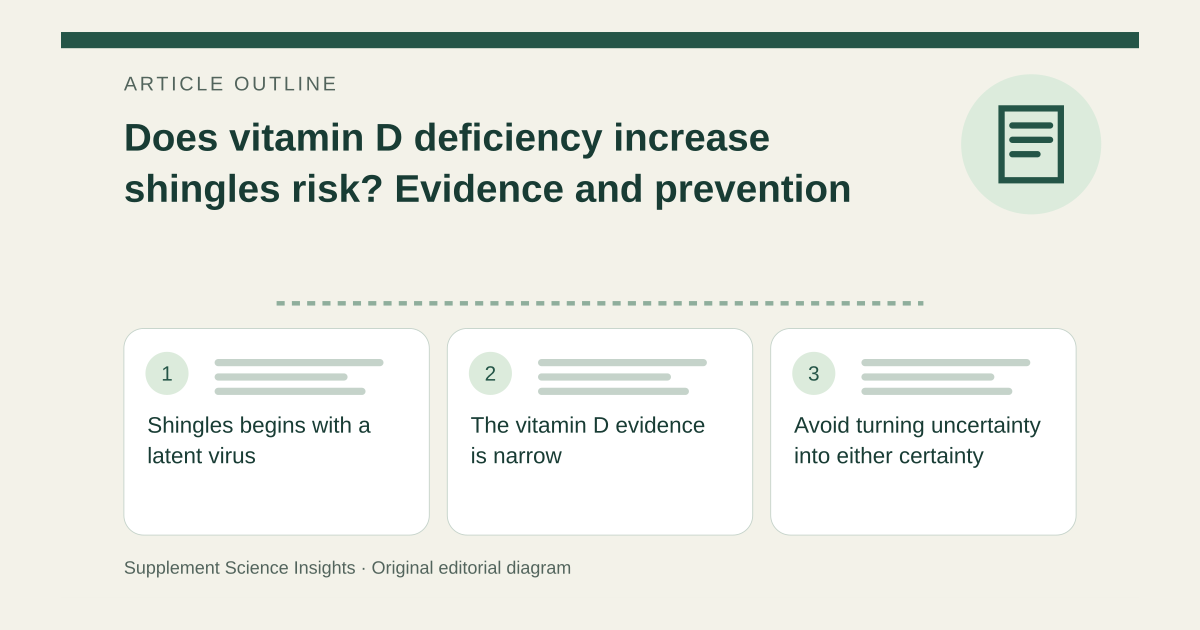
Shingles begins with a latent virus
CDC explains that shingles results from reactivation of varicella-zoster virus after a previous infection. Risk increases as virus-specific immunity declines, particularly with age or immunosuppressive conditions and medicines. A nutritional association does not replace that explanation. [1]
The vitamin D evidence is narrow
A 2021 systematic review included ten studies, all in immunosuppressed patients, covering several herpesviruses. It found no clear association between deficiency and shingles after transplantation in the single relevant study. Other limited findings suggested possible supplementation benefits in particular settings, but the overall association remained inconclusive. [2]
Avoid turning uncertainty into either certainty
These data do not prove that vitamin D has no role under any circumstances. They also do not establish that deficiency caused a particular outbreak or that extra vitamin D prevents shingles in the general population. Correcting deficiency and preventing shingles are separate clinical goals. [2][3]
Use established prevention and assessment
CDC recommends recombinant shingles vaccination for eligible adults, including adults 50 and older and certain immunocompromised adults 19 and older. Vitamin D supplementation is not an equivalent substitute. A suspected shingles rash warrants clinical attention rather than waiting for a nutrient strategy to work. [1]
Interpret a risk headline
Imagine an article reports a finding in dialysis patients and labels vitamin D a shingles shield. The population and limited study evidence matter. A person outside that setting cannot assume the same effect or use the headline to choose a supplement dose. [2]
| Issue | What evidence supports |
|---|---|
| Latent varicella-zoster virus | Underlying cause of shingles |
| Age or immunosuppression | Established risk factors |
| Low D in a selected patient group | Not universal causal proof |
| Eligible for vaccination | Discuss established prevention |
Sources for this article
- Clinical Overview of Shingles (Herpes Zoster) | Shingles (Herpes Zoster) | CDC
Source consulted: 2026-09-21. This is a reference resource, not a claim that we conducted the studies or tested a product. - Vitamin D Deficiency or Supplementation and the Risk of Human Herpesvirus Infections or Reactivation: A Systematic Review and Meta-analysis.
Source consulted: 2026-09-21. This is a reference resource, not a claim that we conducted the studies or tested a product. - Vitamin D - Health Professional Fact Sheet
Source consulted: 2026-09-21. This is a reference resource, not a claim that we conducted the studies or tested a product.