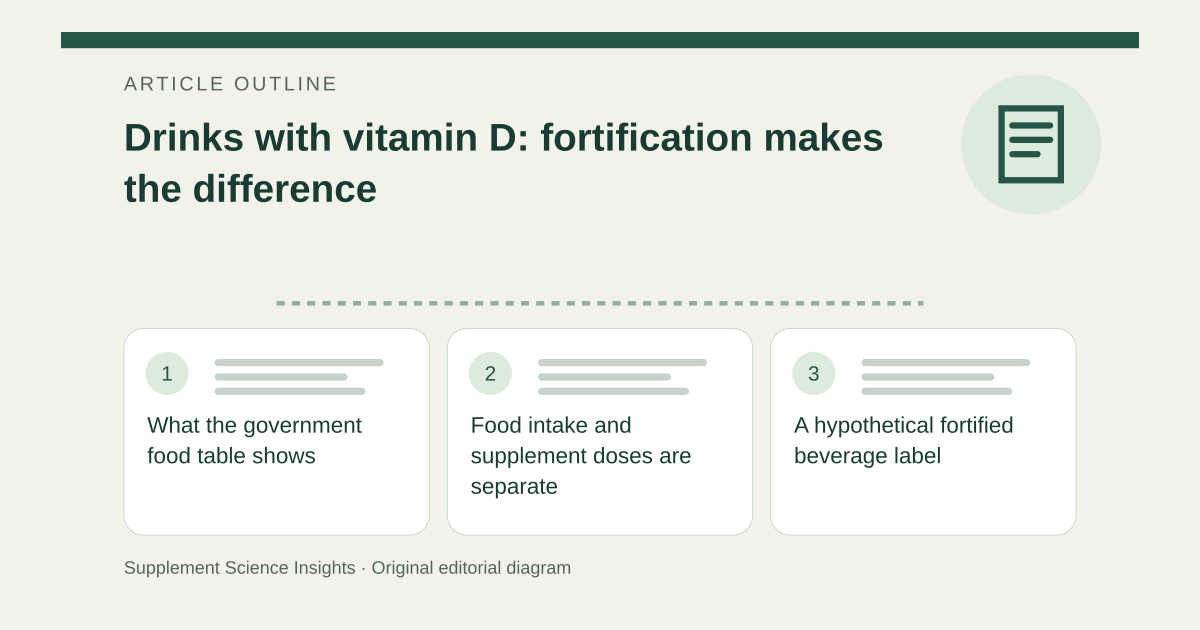
What the government food table shows
NIH ODS lists about 2.9 mcg vitamin D per cup of fortified 2% milk and 2.5–3.6 mcg per cup for selected fortified soy, almond and oat beverages. Some orange-juice brands are fortified too. These are reference examples, not a promise that every product in those categories contains vitamin D. [1]
Food intake and supplement doses are separate
Read the actual micrograms per serving and the volume consumed. The general U.S. total-intake recommendation is 15 mcg daily for most people aged 1–70 and 20 mcg after 70; infants have an Adequate Intake of 10 mcg. These are nutritional reference amounts, not individualized deficiency-treatment instructions. Other foods and supplements also contribute. [1]
A hypothetical fortified beverage label
Suppose a carton declares 3 mcg per 240 mL. A 120 mL portion supplies 1.5 mcg and 480 mL supplies 6 mcg. This arithmetic uses an invented label for illustration; it does not identify a brand or recommend drinking that volume. An unfortified version cannot inherit the fortified version’s declared amount. [1]
| Hypothetical beverage volume | Vitamin D from a 3 mcg/240 mL label |
|---|---|
| 120 mL | 1.5 mcg |
| 240 mL | 3 mcg |
| 480 mL | 6 mcg |
Sources for this article
- Vitamin D - Health Professional Fact Sheet
Source consulted: 2026-09-20. This is a reference resource, not a claim that we conducted the studies or tested a product.