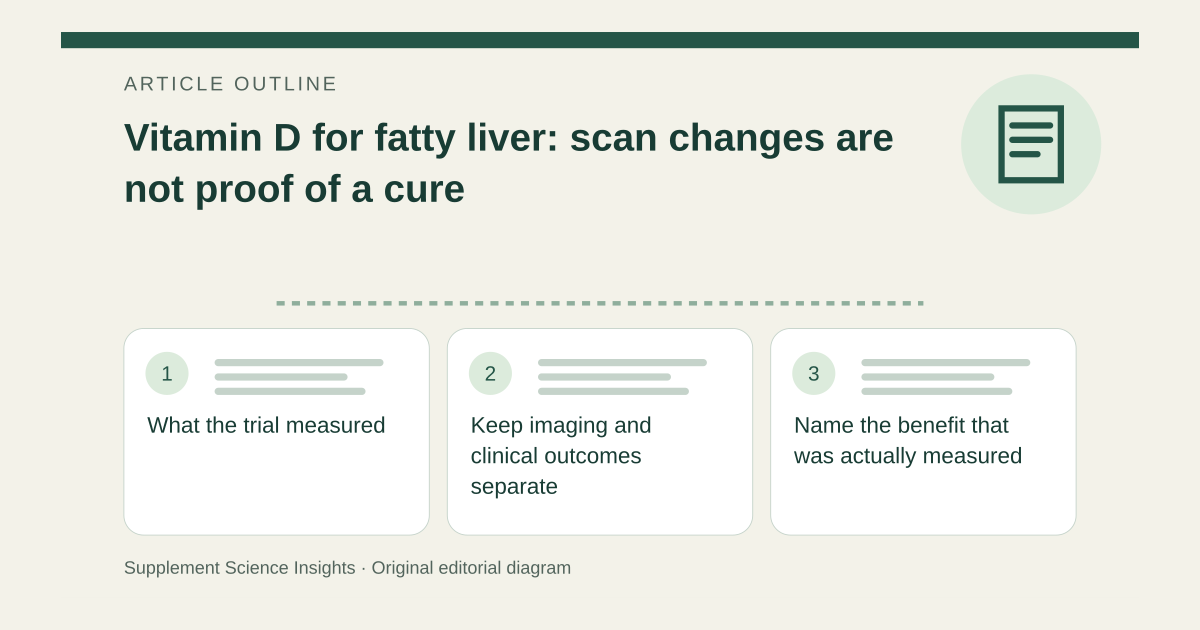
What the trial measured
The study assigned 201 adults with nonalcoholic fatty liver disease to vitamin D and 110 to placebo for 12 months. The co-primary outcomes were changes in controlled attenuation parameter, a scan measure related to liver fat, and liver stiffness measured by transient elastography. [1]
The reported between-group differences favored vitamin D. The confidence interval for the stiffness difference reached 0.00 kPa at its upper limit, which warrants care when describing the precision of that finding. [1]
Keep imaging and clinical outcomes separate
An improved scan measurement is not the same outcome as fewer liver complications or a demonstrated change on liver biopsy. This single-centre trial cannot establish those benefits when they were not its primary endpoints. [1]
The funding record states that the authors declared no financial support. The abstract does not provide a complete assessment of conflicts, adherence or longer-term clinical outcomes. The result is a reason for further evaluation, not a general supplement prescription for everyone with fatty liver. [1]
Name the benefit that was actually measured
Imagine a study shows a lower liver-stiffness measurement. Calling that an imaging improvement is accurate; calling it proof that cirrhosis was prevented adds an outcome the study did not establish.
| Detail | Interpretation |
|---|---|
| 311 participants | Single-centre trial |
| 12 months | Follow-up duration |
| Elastography | Surrogate measurements |
Sources for this article
- Vitamin D for treatment of non-alcoholic fatty liver disease detected by transient elastography: A randomized, double-blind, placebo-controlled trial - PubMed
Source consulted: 2026-09-19. This is a reference resource, not a claim that we conducted the studies or tested a product.