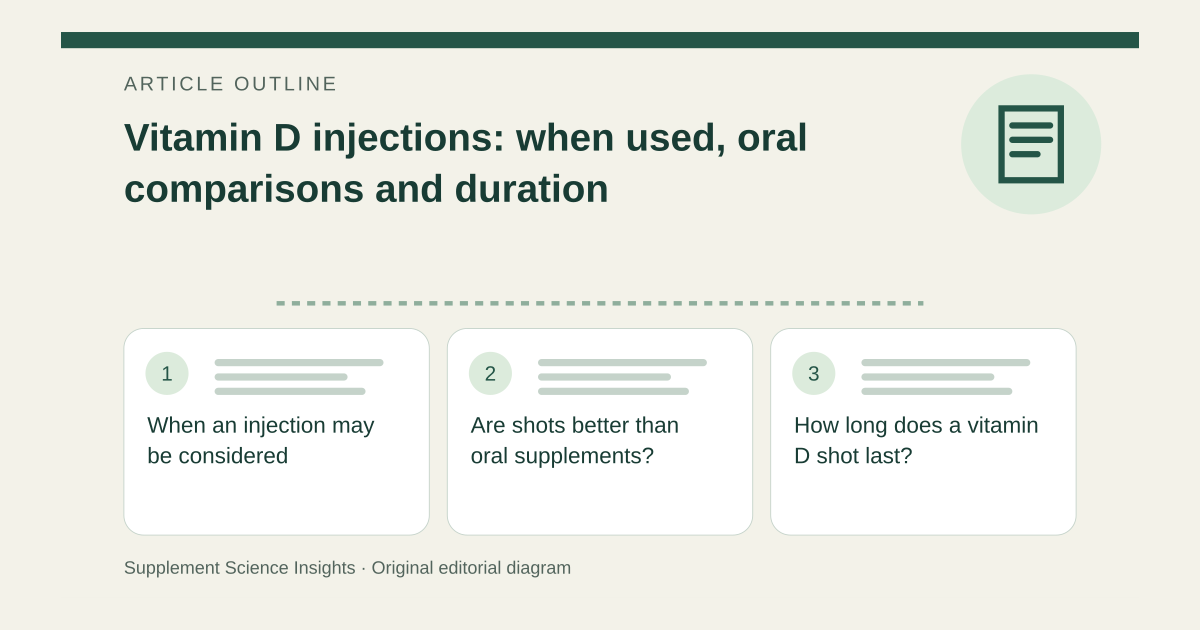
When an injection may be considered
The UK prescribing information for one ergocalciferol, or vitamin D2, injection lists gastrointestinal, liver or biliary disease associated with vitamin D malabsorption and resulting mineral or bone disorders. It specifies intramuscular administration. This is a particular prescription product and indication, not evidence that every wellness injection has the same formulation or role. [1]
Are shots better than oral supplements?
A 2024 international consensus statement identifies oral vitamin D as the preferred route and reserves parenteral treatment for selected clinical situations. Bypassing the gut can be relevant when absorption is a problem, but an injection is not inherently more effective for someone who absorbs and takes oral treatment adequately. Route, formulation, dose and adherence all affect the comparison. [2]
How long does a vitamin D shot last?
There is no universal duration. The inspected D2 product label describes a typical adult repeat interval of three to six months while requiring individualized dosing and laboratory monitoring. That interval describes clinical use of this product; it does not mean every recipient remains sufficient for six months or that the vitamin has completely disappeared by then. [1]
A blood-marker half-life is a different number
NIH describes a circulating half-life of about fifteen days for 25-hydroxyvitamin D, the principal status marker. That does not directly measure release from an injection depot, total body stores or the duration of a clinical effect. Repeat treatment should follow the prescribed monitoring plan rather than a simplified half-life calculation. [3]
Administration and follow-up belong together
The injection label requires monitoring to avoid excessive calcium and other complications. A high-dose injection should be administered within medical care using the intended injectable product; oral drops or capsule contents are not interchangeable injectable preparations. Tell the clinician about other vitamin D and calcium sources before treatment. [1]
Compare the actual options
Imagine a patient has confirmed malabsorption and persistent deficiency despite an assessed oral regimen. An injection may address a real delivery problem. Someone with no absorption problem cannot infer the same advantage from the word shot, and neither person should repeat treatment solely because a calendar interval has passed. [2][1]
| Question | Relevant distinction |
|---|---|
| Why inject? | Selected clinical need, such as malabsorption |
| Is it better? | Depends on absorption, adherence and regimen |
| How long does it last? | Product and response, not a universal interval |
| What determines the next dose? | Clinical and laboratory follow-up |
Sources for this article
- Ergocalciferol 300,000IU Solution for Injection - Summary of Product Characteristics (SmPC) - (emc) | 9133
Source consulted: 2026-09-21. This is a reference resource, not a claim that we conducted the studies or tested a product. - Consensus Statement on Vitamin D Status Assessment and Supplementation: Whys, Whens, and Hows.
Source consulted: 2026-09-21. This is a reference resource, not a claim that we conducted the studies or tested a product. - Vitamin D - Health Professional Fact Sheet
Source consulted: 2026-09-21. This is a reference resource, not a claim that we conducted the studies or tested a product.