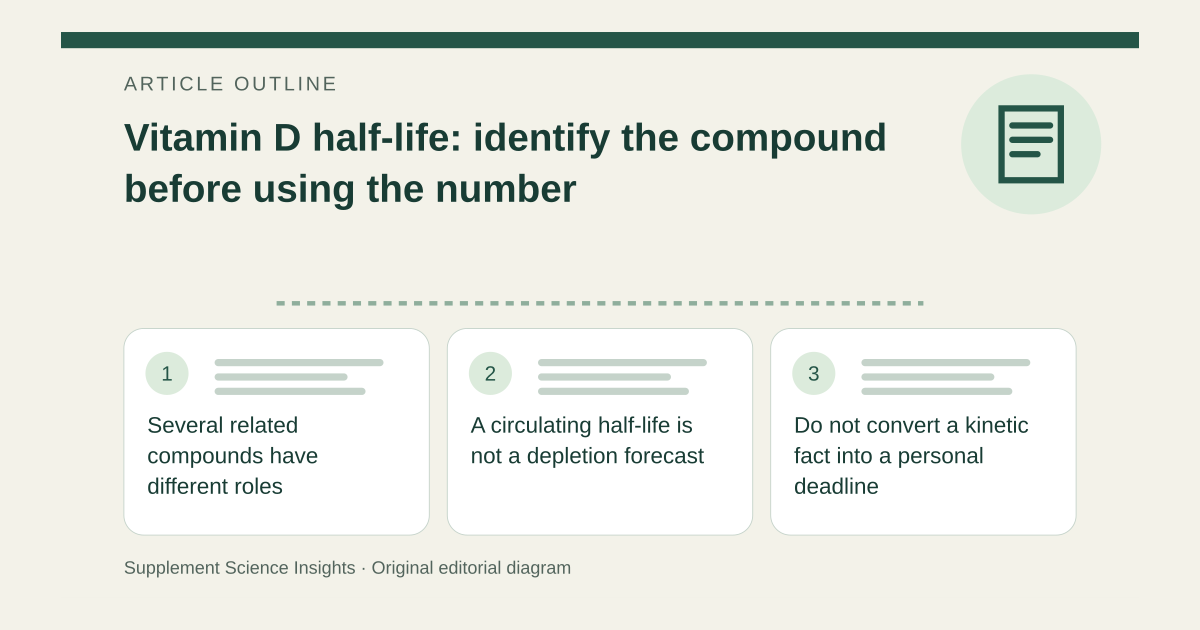
Several related compounds have different roles
Vitamin D undergoes conversion in the liver to 25-hydroxyvitamin D, the main blood marker used to assess status. Further activation occurs primarily in the kidneys to produce 1,25-dihydroxyvitamin D. ODS describes the latter’s circulating half-life in hours, compared with about 15 days for 25-hydroxyvitamin D. [1]
Using the word vitamin D for all three without identifying the measured compound obscures which kinetic estimate is being discussed. A short-lived active hormone and a longer-lived status marker are not contradictory findings. [1]
A circulating half-life is not a depletion forecast
The blood marker reflects input from skin production, food and supplements. A simplified half-life calculation assumes conditions that may not describe an individual’s ongoing inputs and metabolism. It cannot establish when someone will become deficient after stopping a product. [1]
Nor does the number define when toxicity will resolve or when treatment should be repeated. Those are clinical questions requiring the exposure history, relevant blood results and symptoms. [1]
Do not convert a kinetic fact into a personal deadline
Imagine someone reads 15 days and concludes all vitamin D is gone after a month. Even a simple half-life model does not mean complete disappearance, and real physiology includes continuing inputs and multiple compounds.
| Detail | Meaning |
|---|---|
| 25-hydroxyvitamin D | About 15-day circulating half-life |
| Active metabolite | Half-life measured in hours |
| Whole-body depletion | Not determined by one number |
Sources for this article
- NIH ODS: Vitamin D
Source consulted: 2026-09-17. This is a reference resource, not a claim that we conducted the studies or tested a product.