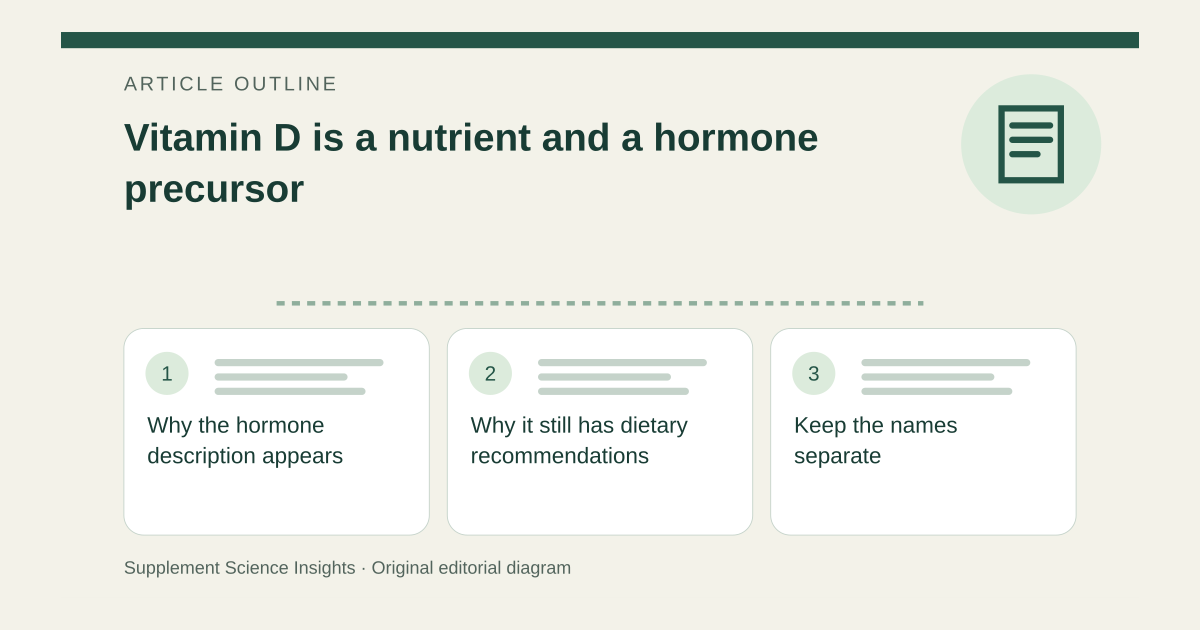
Why the hormone description appears
The National Academies report describes vitamin D as a prohormone in the seco-sterol family. The body converts the nutritional forms through an activation pathway. Calcitriol, the active metabolite, acts through the vitamin D receptor to regulate functions including calcium and phosphate balance. Calling vitamin D a hormone often compresses this whole pathway into one phrase. [1]
Why it still has dietary recommendations
Vitamin D can come from food and supplements, and skin can produce it after UV exposure. The NIH ODS fact sheet explains that vitamin D first becomes 25-hydroxyvitamin D in the liver, then the active 1,25-dihydroxy form primarily in the kidney. Nutrient intake and hormone action therefore are not competing explanations. The existence of skin synthesis does not mean every person produces enough. [2]
Keep the names separate
Imagine a supplement says cholecalciferol while a laboratory report lists 25(OH)D. These refer to different substances in the same pathway. A prescription for calcitriol is another distinct entry; it should not be treated as interchangeable with an ordinary D 3 product. Read the exact name before making comparisons. [2]
| Name in a hypothetical record | Place in the pathway |
|---|---|
| Cholecalciferol, D 3 | Nutritional precursor |
| 25(OH)D | Major circulating status marker |
| Calcitriol | Activated hormone |
Sources for this article
- Institute of Medicine: Overview of Vitamin D (2011)
Source consulted: 2026-09-20. This is a reference resource, not a claim that we conducted the studies or tested a product. - Vitamin D - Health Professional Fact Sheet
Source consulted: 2026-09-20. This is a reference resource, not a claim that we conducted the studies or tested a product.