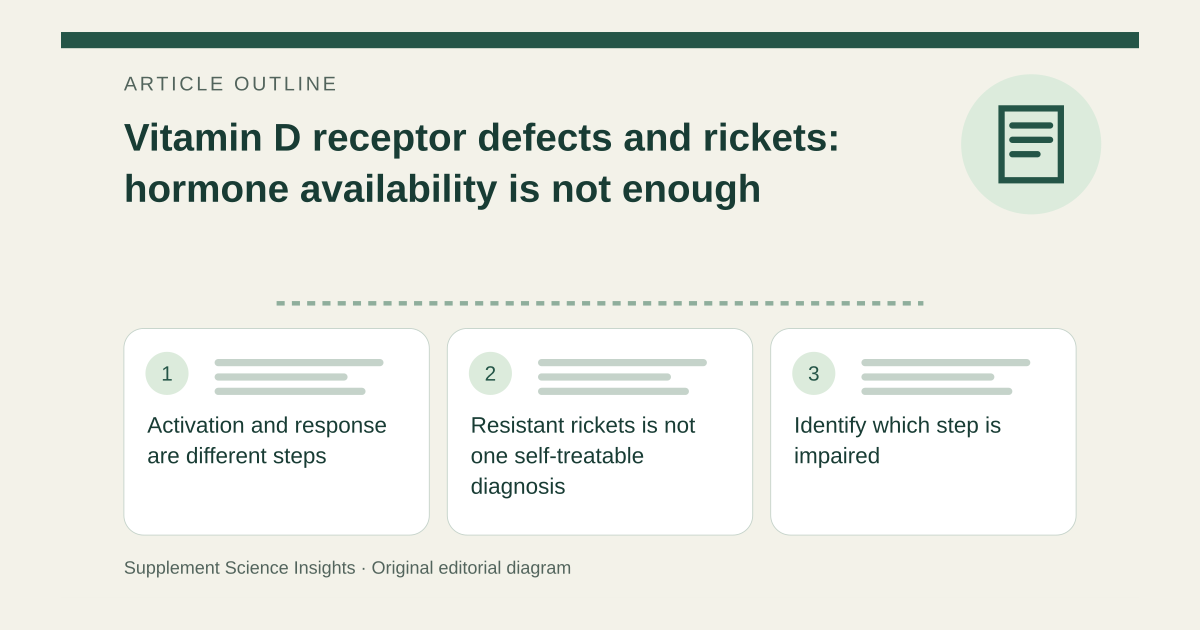
Activation and response are different steps
MedlinePlus Genetics distinguishes disorders affecting conversion of vitamin D into calcitriol from VDR-related disease affecting the receptor’s interaction with calcitriol or DNA. Both can disturb regulation of calcium and phosphate. [1]
The receptor defect therefore is not simply a dietary shortage. Normal availability of the hormone does not guarantee an effective cellular response. [1]
Resistant rickets is not one self-treatable diagnosis
This page focuses on VDR-related vitamin D-dependent rickets, rather than treating every use of the phrase resistant rickets as the same disease. Genetic and mineral abnormalities require specialist assessment. [1]
Affected children can have impaired bone mineralization and other manifestations. Standard nutritional vitamin D dosing cannot be assumed to correct the underlying disorder, and dose escalation without diagnosis is not an appropriate substitute for care. [1]
Identify which step is impaired
Imagine one child cannot efficiently activate vitamin D and another has defective receptor signaling. Both may have rickets, but the same explanation and treatment assumptions do not fit both mechanisms.
| Detail | Interpretation |
|---|---|
| Activation defect | Insufficient active hormone production |
| Receptor defect | Impaired response |
| Similar bone findings | Can have different causes |
Sources for this article
- Vitamin D-dependent rickets: MedlinePlus Genetics
Source consulted: 2026-09-17. This is a reference resource, not a claim that we conducted the studies or tested a product.