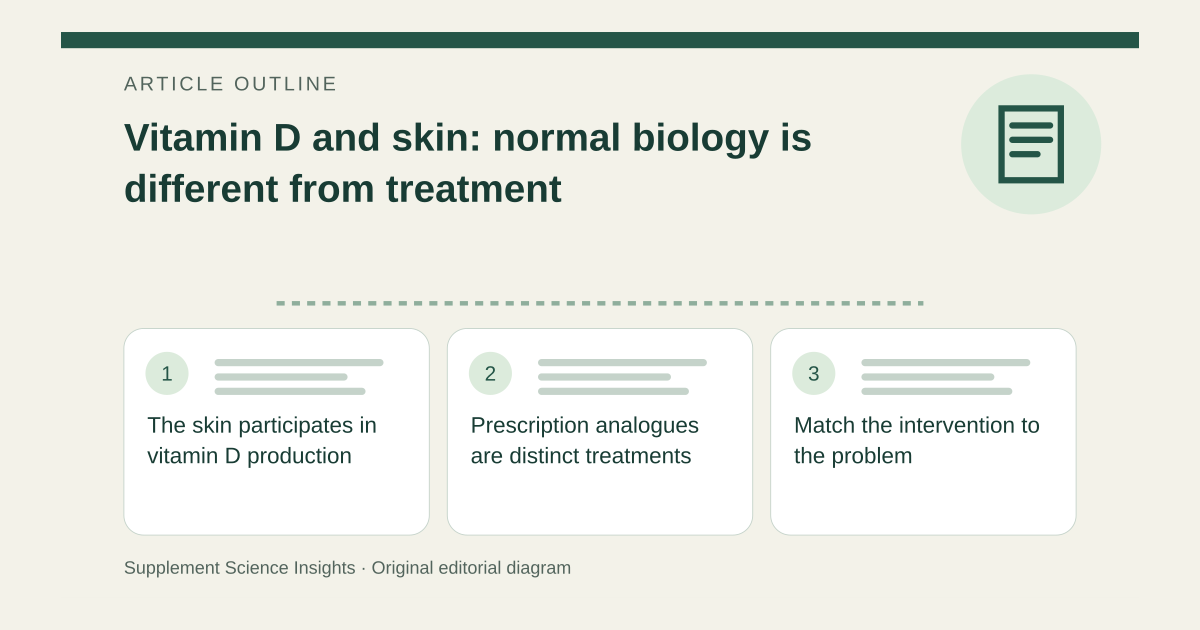
The skin participates in vitamin D production
ODS describes UVB-driven synthesis and vitamin D’s roles in cell growth and immune function. A biological role helps explain why the nutrient matters, but it does not establish that increasing intake above need improves skin appearance or repairs a particular rash. [1]
Prescription analogues are distinct treatments
AAD explains that synthetic vitamin D medicines used for psoriasis can slow excessive skin-cell growth and reduce scaling. These prescribed topical preparations are not interchangeable with oral vitamin D supplements or an opened capsule rubbed onto the skin. Their use depends on the diagnosis and treatment plan. [2]
Match the intervention to the problem
Imagine someone has a persistent scaly patch and a low vitamin D result. Correcting a nutritional problem and diagnosing the patch are separate tasks. Avoid substituting high-dose supplements or extra tanning for appropriate skin care; excessive vitamin D and UV exposure each have their own risks. [1][2][3]
| Concern | Useful distinction |
|---|---|
| Normal cell regulation | Does not prove extra-dose benefit |
| Topical vitamin D analogue | A specific prescription treatment |
| Oral nutritional supplement | Not interchangeable with a skin medicine |
Sources for this article
- Vitamin D - Health Professional Fact Sheet
Source consulted: 2026-09-20. This is a reference resource, not a claim that we conducted the studies or tested a product. - Psoriasis treatment: Synthetic vitamin D
Source consulted: 2026-09-20. This is a reference resource, not a claim that we conducted the studies or tested a product. - Sunscreen FAQs
Source consulted: 2026-09-20. This is a reference resource, not a claim that we conducted the studies or tested a product.