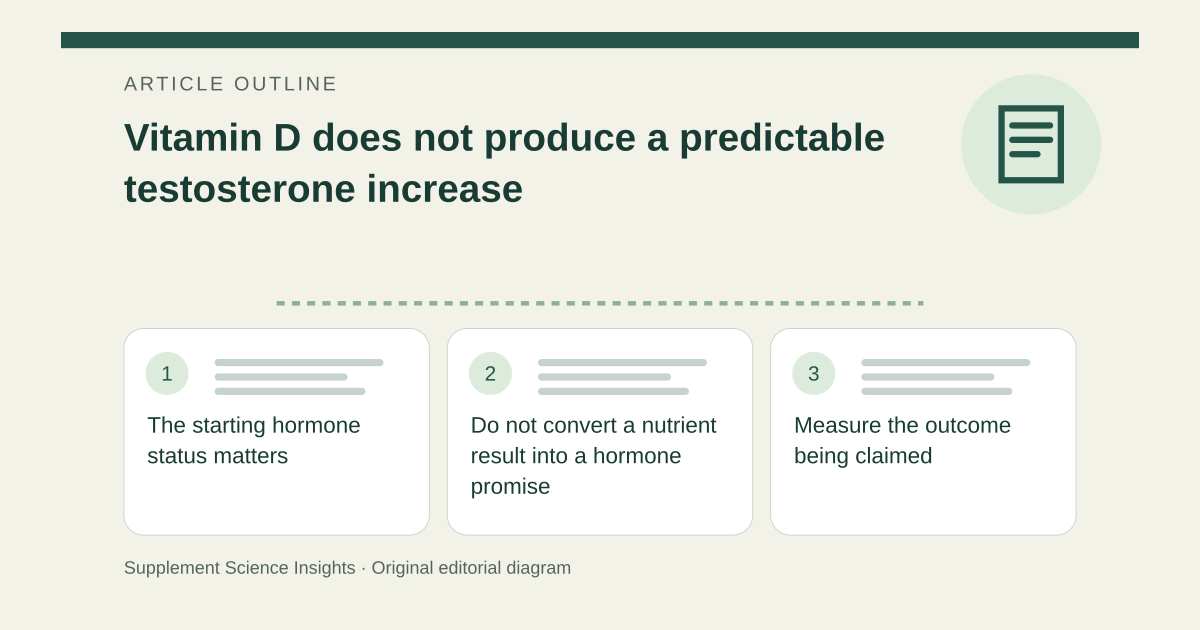
The starting hormone status matters
The Graz trial randomized 100 men to weekly vitamin D3 or placebo for 12 weeks; 98 completed it. Participants had normal-range baseline total testosterone and vitamin D concentrations below the study threshold of 75 nmol/L. [1]
The main outcome was total testosterone measured by mass spectrometry. The investigators found no significant treatment effect on that outcome. This is more informative about causation than simply observing that vitamin D and testosterone levels correlate. [1]
Do not convert a nutrient result into a hormone promise
The study does not establish an expected percentage or numerical testosterone gain. Nor does one trial in men with normal baseline testosterone settle every question about people with a diagnosed hormone disorder. [1]
A vitamin D indication and a testosterone assessment are separate clinical questions. Raising a vitamin D blood concentration does not itself demonstrate improved testosterone, fertility, sexual function or muscle growth. Funding and conflicts could not be fully assessed from the abstract used here. [1]
Measure the outcome being claimed
Imagine a supplement raises vitamin D on a blood test while testosterone stays the same. The nutrient change cannot be presented as evidence that the product increased testosterone.
| Detail | Interpretation |
|---|---|
| 100 randomized | 98 completed |
| 12 weeks | Trial duration |
| Total testosterone | No significant treatment effect |
Sources for this article
- Vitamin D and Testosterone in Healthy Men: A Randomized Controlled Trial - PubMed
Source consulted: 2026-09-19. This is a reference resource, not a claim that we conducted the studies or tested a product.