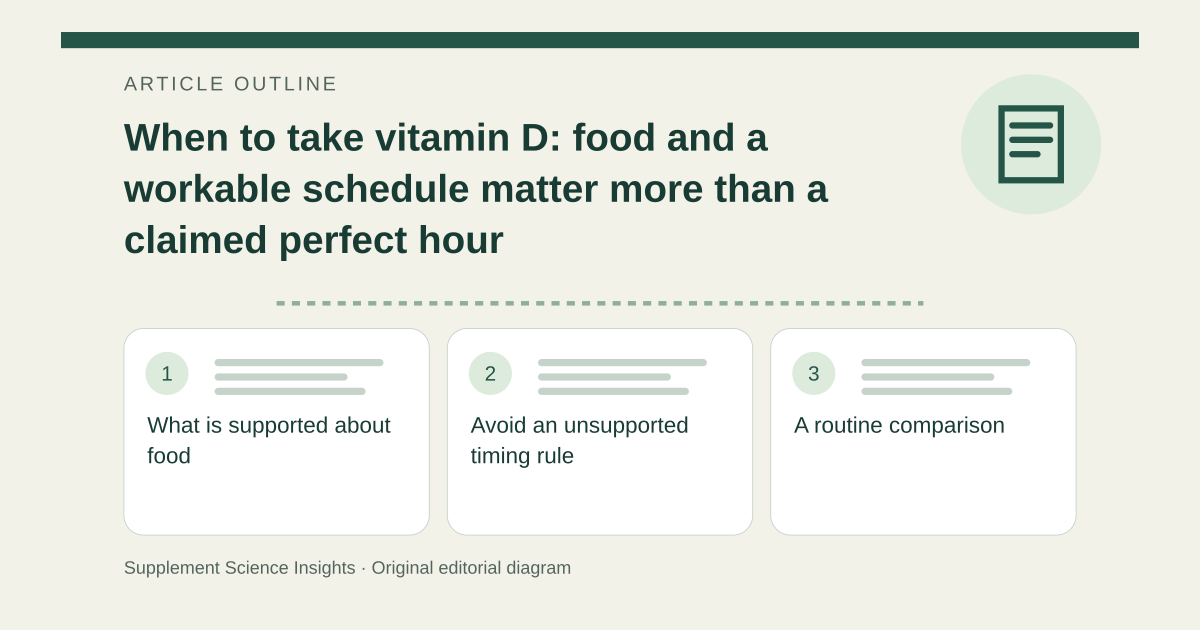
What is supported about food
NIH ODS reports that dietary fat present in the intestine enhances vitamin D absorption, although some absorption occurs without fat. Taking a product with a usual meal containing some fat can therefore be a practical approach when compatible with its directions. This does not mean a high-fat meal is required or that a fasting dose is completely wasted. [1]
Avoid an unsupported timing rule
The absorption guidance does not identify one clock time that works best for everyone. Morning and evening routines differ, and a claim that vitamin D must always be taken at one hour needs evidence beyond the fact that it is fat soluble. Follow the specific product or prescribed regimen; a daily supplement and an intermittent treatment are not the same schedule. [1]
A routine comparison
Imagine breakfast is routinely skipped but dinner is reliable and contains some dietary fat. Dinner can be a practical reminder for a daily product, provided its instructions allow that schedule. This is an adherence example, not a trial showing dinner is biologically superior. Do not double doses simply to move the time of day. [1]
| Hypothetical routine | Interpretation |
|---|---|
| Reliable breakfast with dietary fat | A possible meal-based reminder |
| Breakfast skipped, dinner reliable | A different workable reminder |
| Clinician-directed intermittent regimen | Follow that schedule rather than a generic daily rule |
Sources for this article
- Vitamin D - Health Professional Fact Sheet
Source consulted: 2026-09-20. This is a reference resource, not a claim that we conducted the studies or tested a product.