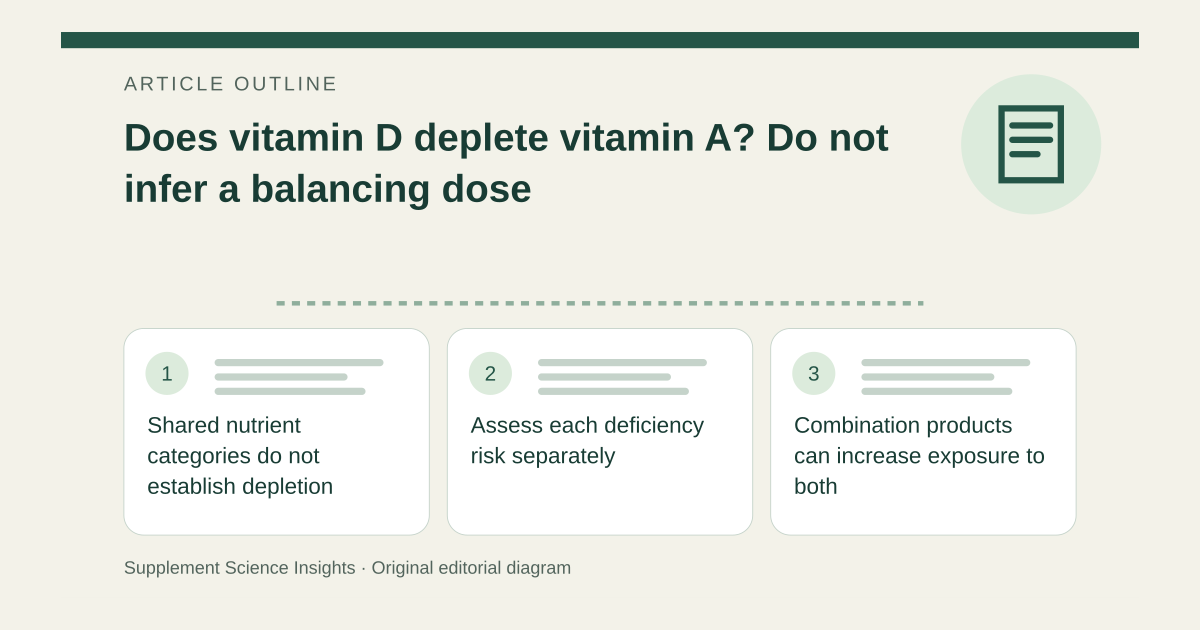
Shared nutrient categories do not establish depletion
Vitamins A and D both have important biological roles, but that does not mean each dose of one consumes a fixed amount of the other. A biochemical interaction claim needs evidence for actual nutrient status or health outcomes, not just an analogy about balance. [1][2]
Assess each deficiency risk separately
NIH describes vitamin A deficiency in relation to intake and absorption and vitamin D inadequacy in relation to intake, sun exposure, absorption and metabolism. A person can have more than one nutritional problem, but one supplement is not automatically the cause of the other. [1][2]
Combination products can increase exposure to both
Check multivitamins and oils that contain both nutrients. Add the actual amounts from every product rather than assuming a combination has an ideal ratio. The form of vitamin A matters: preformed vitamin A and provitamin A carotenoids have different safety considerations. [1][2][3]
Avoid a high-dose balancing strategy
Excess preformed vitamin A can be harmful, including during pregnancy, while excessive vitamin D can cause hypercalcemia. There is no general instruction in the inspected guidance to offset one large dose with another. Follow a targeted clinical plan when treating a diagnosed deficiency. [1][2]
Ask what finding needs correction
Imagine someone taking prescribed vitamin D buys retinol because of a depletion claim. First review dietary intake, existing supplements and any evidence of vitamin A deficiency. A marketing explanation is not itself a reason to add another high-dose nutrient. [1][2][3]
| Question | Useful evidence |
|---|---|
| Is either nutrient low? | Appropriate clinical assessment |
| What products overlap? | Actual amounts and forms |
| Is a ratio prescribed? | A specific treatment rationale |
| Could more cause harm? | Separate toxicity considerations |
Sources for this article
- Vitamin A and Carotenoids - Health Professional Fact Sheet
Source consulted: 2026-09-21. This is a reference resource, not a claim that we conducted the studies or tested a product. - Vitamin D - Health Professional Fact Sheet
Source consulted: 2026-09-21. This is a reference resource, not a claim that we conducted the studies or tested a product. - Dietary Supplements: What You Need to Know
Source consulted: 2026-09-21. This is a reference resource, not a claim that we conducted the studies or tested a product.