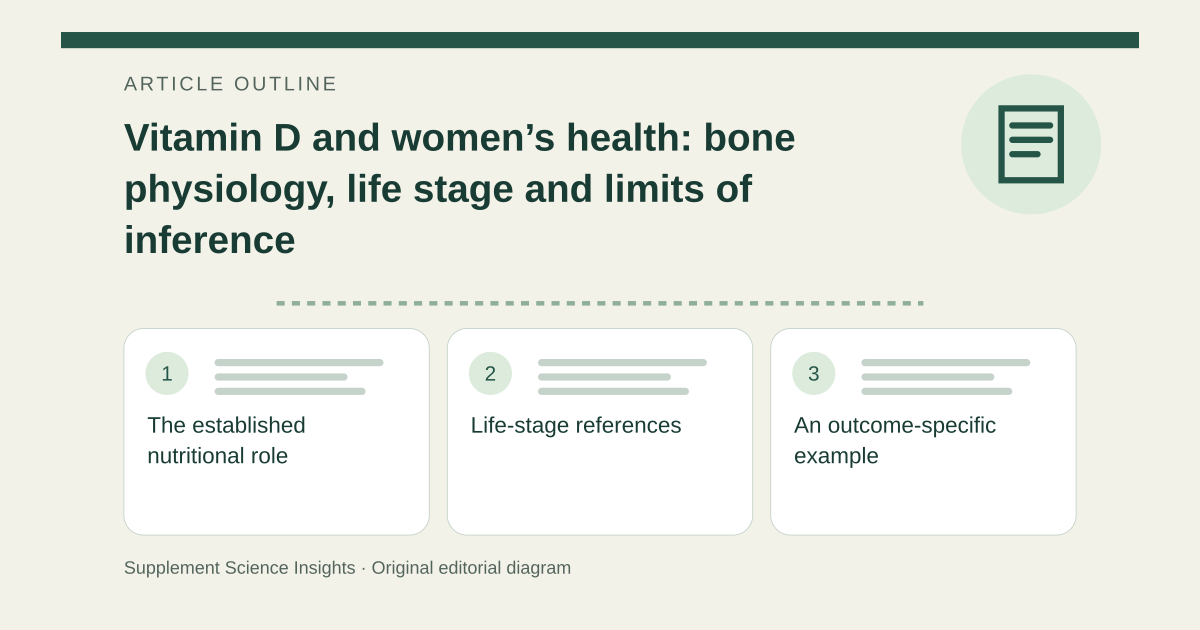
The established nutritional role
Vitamin D helps maintain calcium and phosphate balance and supports normal bone mineralization. Deficiency can cause osteomalacia in adults. These functions apply to women as well as men; they should be distinguished from claims that additional vitamin D improves every symptom associated with hormones, fertility or menopause. [1]
Life-stage references
The U.S. RDA is 600 IU daily through age 70, including pregnancy and lactation, and 800 IU afterward. These include foods and supplements and assume minimal sun exposure. A higher-dose treatment for a diagnosed problem has a separate purpose, and the normal adult upper limit is 4,000 IU total daily. [1]
An outcome-specific example
Imagine someone has adequate intake but is considering a large extra dose for hot flashes. The fact that vitamin D supports bones does not establish that it treats hot flashes. If there is a bone-health or deficiency concern, assess that specific issue with the clinician rather than assigning every women’s-health claim to one nutrient function. [1]
| Hypothetical goal | Evidence distinction |
|---|---|
| Meet vitamin D needs | Nutritional reference applies |
| Treat confirmed deficiency | Clinical regimen and follow-up |
| Relieve hot flashes | Requires outcome-specific evidence |
Sources for this article
- Vitamin D - Health Professional Fact Sheet
Source consulted: 2026-09-20. This is a reference resource, not a claim that we conducted the studies or tested a product.