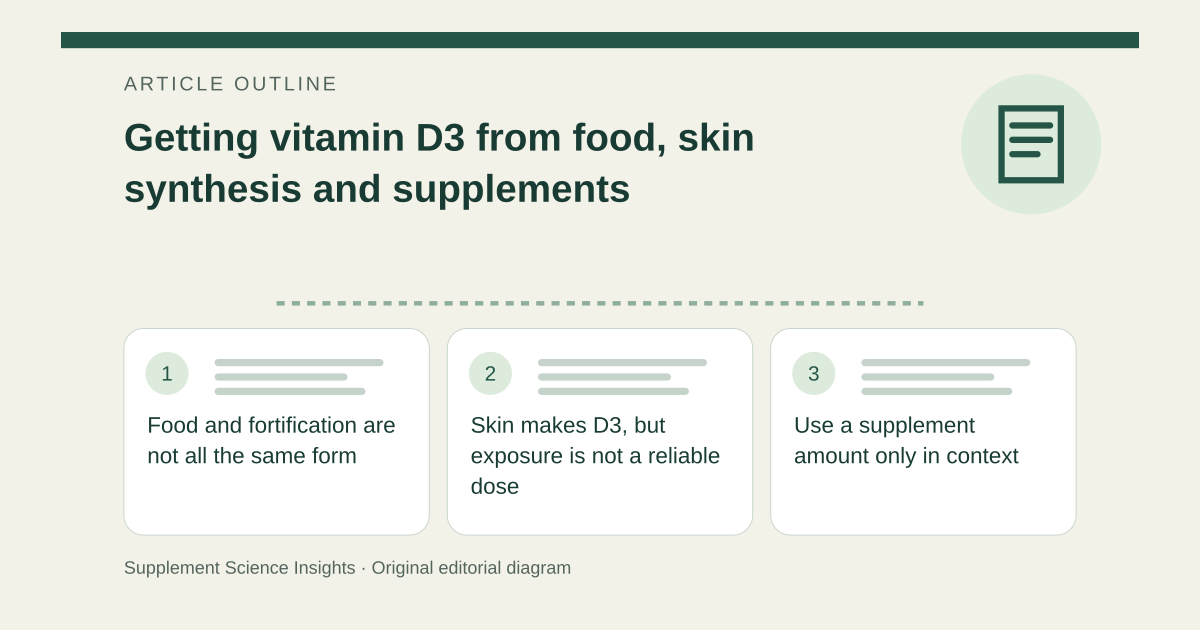
Food and fortification are not all the same form
Vitamin D 3 is cholecalciferol. Fatty fish and some other animal foods provide it; fortified foods may use D 2 or D 3, so the ingredient information matters when the form is relevant. Both are vitamin D forms. A food’s total vitamin D amount should not be assumed to be entirely D 3 if the form is unspecified. [1]
Skin makes D3, but exposure is not a reliable dose
UVB exposure can trigger skin synthesis, yet season, skin characteristics, age and other factors affect production. Window glass blocks the UVB needed for this pathway. NIH ODS emphasizes skin protection because UV exposure carries risk; tanning or a fixed unprotected-sun schedule is not a dependable measured intake plan. [1]
Use a supplement amount only in context
A hypothetical D 3 product labeled 10 mcg supplies 400 IU, using 40 IU per microgram. Whether supplementation is needed depends on total intake and individual circumstances, not merely preferring the D 3 name. The general adult RDA is 600 IU through age 70 and 800 IU thereafter, based on minimal sun exposure; these are intake references rather than instructions to add that amount regardless of food. [1]
| Hypothetical source | Interpretation |
|---|---|
| D 3 supplement 10 mcg | 400 IU |
| Fortified food listing vitamin D only | Check ingredients if form matters |
| Sun through a window | Not a dependable D 3 synthesis source |
Sources for this article
- Vitamin D - Health Professional Fact Sheet
Source consulted: 2026-09-20. This is a reference resource, not a claim that we conducted the studies or tested a product.