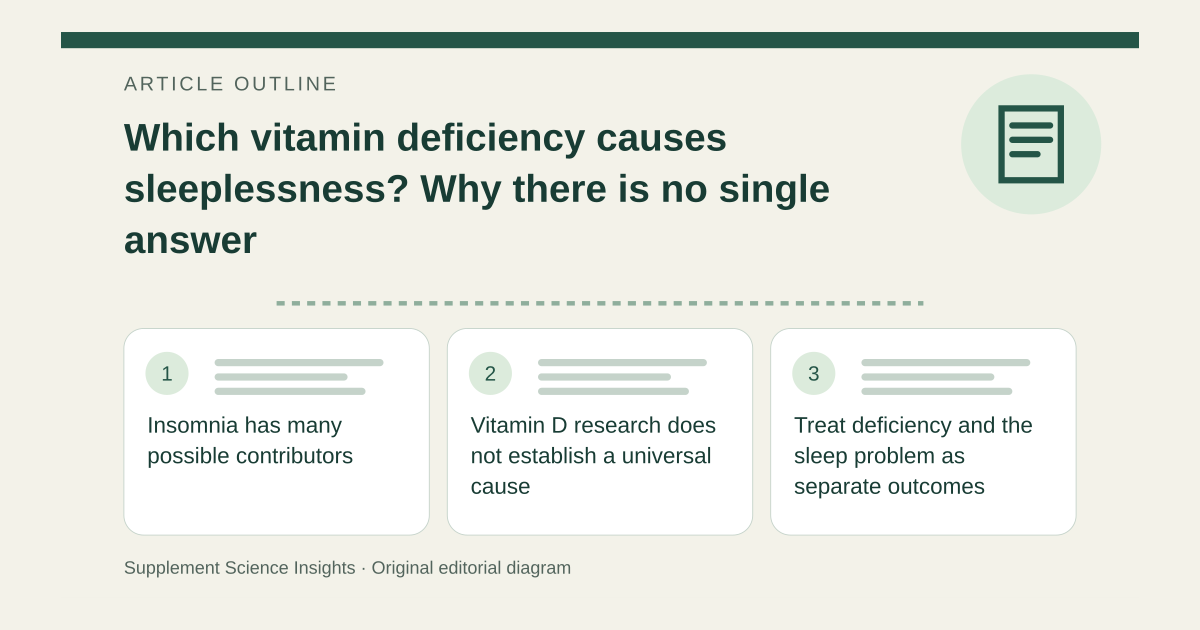
Insomnia has many possible contributors
NHS lists stress, anxiety, medicines, caffeine and other conditions among possible causes. Difficulty falling asleep, repeated waking and daytime impairment should be considered as a pattern. A symptom label alone cannot identify a missing nutrient. [1]
Vitamin D research does not establish a universal cause
A 2022 review of intervention studies found some improvement in sleep-quality scores, but only a small subset of randomized trials contributed to the pooled analysis. Findings for duration, daytime sleepiness and specific disorders were limited or inconsistent. This is not proof that a low vitamin D level caused an individual's insomnia. [2]
Treat deficiency and the sleep problem as separate outcomes
If clinical assessment identifies a deficiency, replacement can be appropriate for nutritional health. The sleep evidence does not establish one vitamin dose or target blood level that reliably treats sleeplessness. Increasing vitamin D despite persistent insomnia can create toxicity without addressing the real contributor. [3][2]
Use established sleep assessment
NHS recommends consistent sleep habits and assessment when problems persist or interfere with daily life. Cognitive behavioral therapy can be part of treatment. If another sleep disorder is suspected, its evaluation should not be replaced by a supplement trial. [1]
A low result is not the whole explanation
Imagine vitamin D status improves but a person still drinks caffeine late and has prolonged insomnia. The unchanged symptom does not prove that another vitamin must be missing. Review the sleep pattern and treatment plan rather than cycling through increasingly large supplement doses. [1][3]
| Observation | Interpretation |
|---|---|
| Sleeplessness alone | Not a vitamin-deficiency diagnosis |
| Low vitamin D | May need care but may not explain insomnia |
| Improved sleep-quality score in a study | Not proof of treating every sleep disorder |
| Persistent daytime impairment | Seek cause-directed assessment |
Sources for this article
- Insomnia - NHS
Source consulted: 2026-09-21. This is a reference resource, not a claim that we conducted the studies or tested a product. - Vitamin D Supplementation and Sleep: A Systematic Review and Meta-Analysis of Intervention Studies - PMC
Source consulted: 2026-09-21. This is a reference resource, not a claim that we conducted the studies or tested a product. - Vitamin D - Health Professional Fact Sheet
Source consulted: 2026-09-21. This is a reference resource, not a claim that we conducted the studies or tested a product.