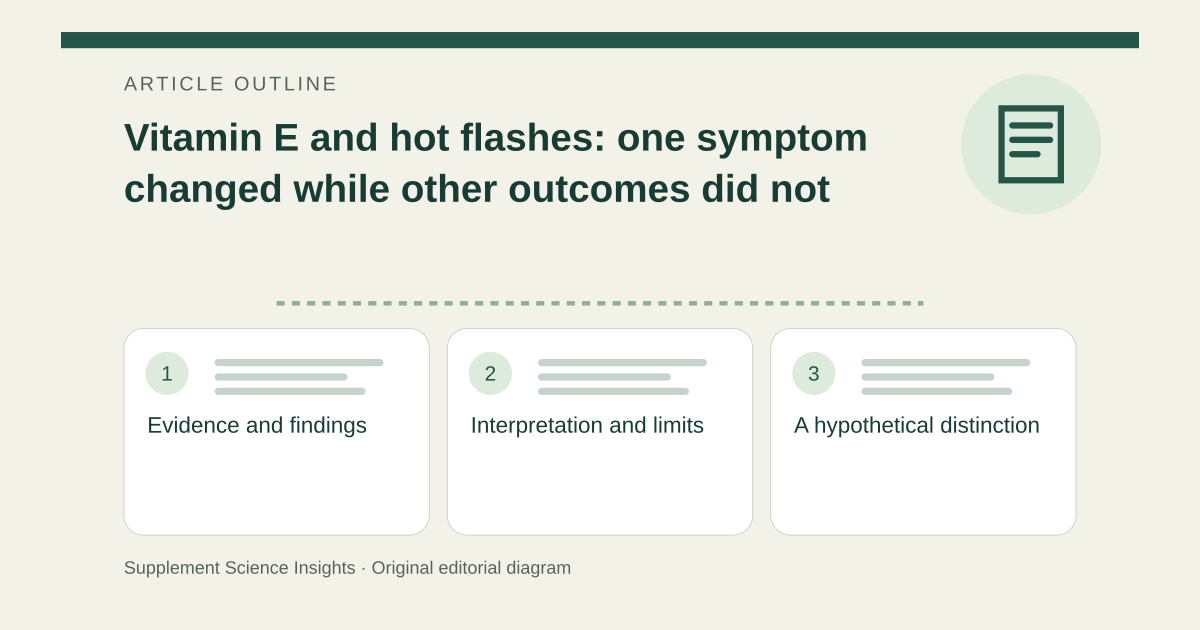
Evidence and findings
Ninety-three postmenopausal women entered a blinded three-arm study comparing curcumin, vitamin E and placebo. Investigators collected hot-flash checklists and several symptom scales. [1]
The vitamin E comparison was not significant at four weeks but reached significance at eight weeks. The other reported symptom-scale comparisons remained nonsignificant. [1]
Interpretation and limits
A later significant assessment does not establish the exact day treatment begins working for an individual. The small, location-specific study also does not settle overall benefit or long-term safety. Funding and conflicts were not established from the abstract; this is one trial rather than a complete evidence synthesis. [1]
A hypothetical distinction
Imagine one symptom improves while a broader questionnaire does not. A claim of global menopause relief would exceed the measured result.
| Detail | Interpretation |
|---|---|
| Hot flashes | Specific outcome |
| Assessment time | Not a precise onset clock |
| Overall symptom relief | Not demonstrated |
Sources for this article
- The effect of oral capsule of curcumin and vitamin E on the hot flashes and anxiety in postmenopausal women: A triple blind randomised controlled trial - PubMed
Source consulted: 2026-09-19. This is a reference resource, not a claim that we conducted the studies or tested a product.