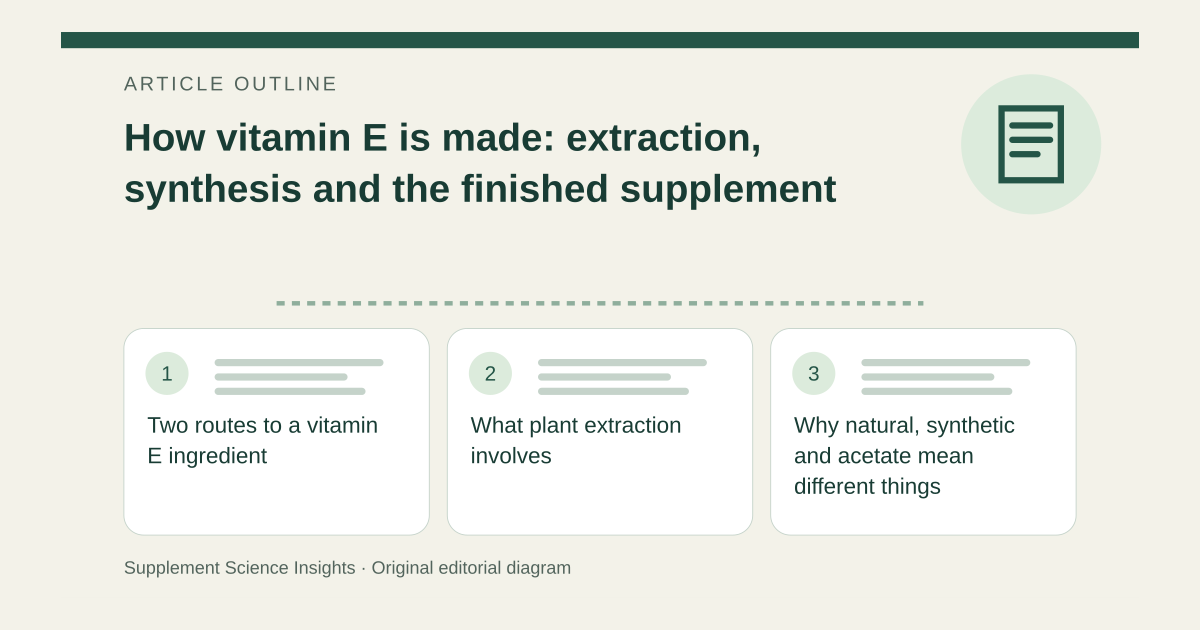
Two routes to a vitamin E ingredient
Vitamin E supplements can begin with vitamin E extracted from plant material or with vitamin E made by chemical synthesis. Those descriptions concern how the ingredient is obtained. They do not tell you whether the finished product is a capsule, a liquid, a powder blend or a suitable supplement for a particular person. [1]
Vitamin E is a family of compounds rather than the name of one interchangeable substance. NIH identifies eight naturally occurring forms, including tocopherols and tocotrienols. Alpha-tocopherol is the form recognized as meeting human vitamin E requirements. A manufacturer therefore needs to identify the specific form as well as its origin. [1]
What plant extraction involves
An example in an FDA-hosted manufacturer notice starts with edible fruit and vegetable material. The manufacturer describes sorting and drying the material, grinding it, extracting the desired components, separating the liquid from plant solids, and drying or protecting the resulting vitamin-rich ingredient. The notice describes more than one extraction approach; it is an example of a documented process, not a recipe used by every vitamin E producer. [2]
Extraction concentrates selected material from a starting food. It does not preserve that food as a complete nutritional package. A vitamin E ingredient obtained from a vegetable cannot, by its origin alone, be counted as a serving of vegetables. The notice is also a manufacturer submission about specified uses, not evidence that taking the ingredient improves a health outcome. [2]
Why natural, synthetic and acetate mean different things
Naturally sourced alpha-tocopherol has the RRR configuration, often written d-alpha-tocopherol. Synthetic all-rac-alpha-tocopherol, often written dl-alpha-tocopherol, contains a mixture of stereoisomers. These molecules differ in spatial arrangement, which matters to vitamin E activity. Comparing an old IU amount across the two forms therefore requires the correct conversion. [1]
Acetate or succinate describes an ester form used to improve stability. That is a separate distinction from natural versus synthetic origin: either source can be esterified. NIH explains that the body can hydrolyze and absorb these esters. Seeing “acetate” alone does not establish that a product is synthetic, and seeing “natural” does not establish that it is unprocessed. [1]
Reading two hypothetical ingredient descriptions
Imagine one label says d-alpha-tocopheryl acetate and another says dl-alpha-tocopheryl acetate. Both use an acetate ester, but the d and dl prefixes identify different source-related stereochemical descriptions. Compare their declared vitamin E amounts using the appropriate units instead of assuming that matching capsule weights mean matching nutrient activity. The manufacturing description is useful for identity; it does not replace evidence about whether supplementation is needed. [1]
| Label detail | What it establishes |
|---|---|
| d-alpha-tocopheryl acetate | Naturally sourced alpha-tocopherol in an acetate ester form |
| dl-alpha-tocopheryl acetate | Synthetic alpha-tocopherol mixture in an acetate ester form |
| Same capsule weight | Does not establish equal vitamin E activity |
Sources for this article
- Vitamin E - Health Professional Fact Sheet
Source consulted: 2026-09-20. This is a reference resource, not a claim that we conducted the studies or tested a product. - GRAS notice 781, Alpha-tocopherol (fruit and vegetable derived)
Source consulted: 2026-09-20. This is a reference resource, not a claim that we conducted the studies or tested a product.