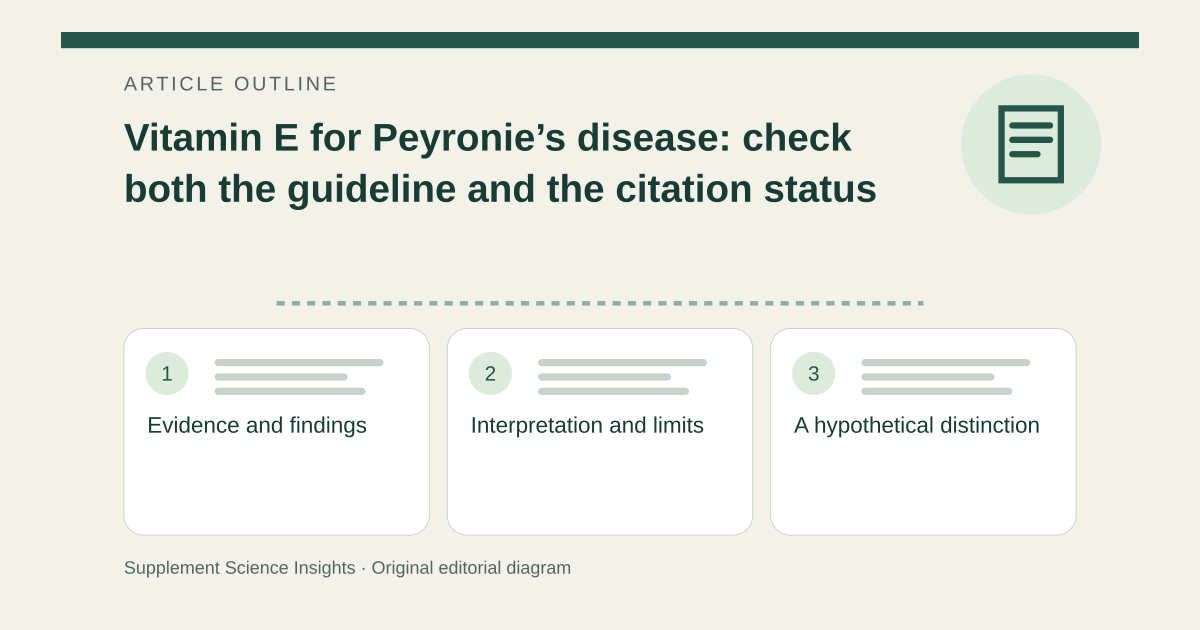
Evidence and findings
The AUA panel found no convincing efficacy evidence for the listed oral therapies, including vitamin E. It identified costs, distress and delay of useful care as burdens even when an ineffective therapy appears tolerable. [1][2]
PubMed links a 2023 expression of concern to the 2007 vitamin E and propionyl-L-carnitine trial. That notice must accompany interpretation of the trial; its results are not treated here as dependable standalone evidence. [1][2]
Interpretation and limits
An expression of concern is a publication-status warning, not proof that the opposite treatment claim is true. The older guideline is reported with its date, not presented as a new trial. Neither source provides a basis for a home vitamin E dosing protocol. [1][2]
A hypothetical distinction
Imagine an older review cites a trial whose status later changes. Reading only the review can miss a material qualification to its evidence base.
| Detail | Interpretation |
|---|---|
| Guideline | Dated synthesis |
| Publication notice | Changes confidence |
| Dose recipe | Not established |
Sources for this article
- Peyronie’s Disease: AUA Guideline - PMC
Source consulted: 2026-09-19. This is a reference resource, not a claim that we conducted the studies or tested a product. - Expression of Concern: Comparison of Vitamin E and Propionyl-L-Carnitine, Separately or in Combination, in Patients With Early Chronic Peyronie's Disease: A Double-Blind, Placebo Controlled, Randomized Study - PubMed
Source consulted: 2026-09-19. This is a reference resource, not a claim that we conducted the studies or tested a product.