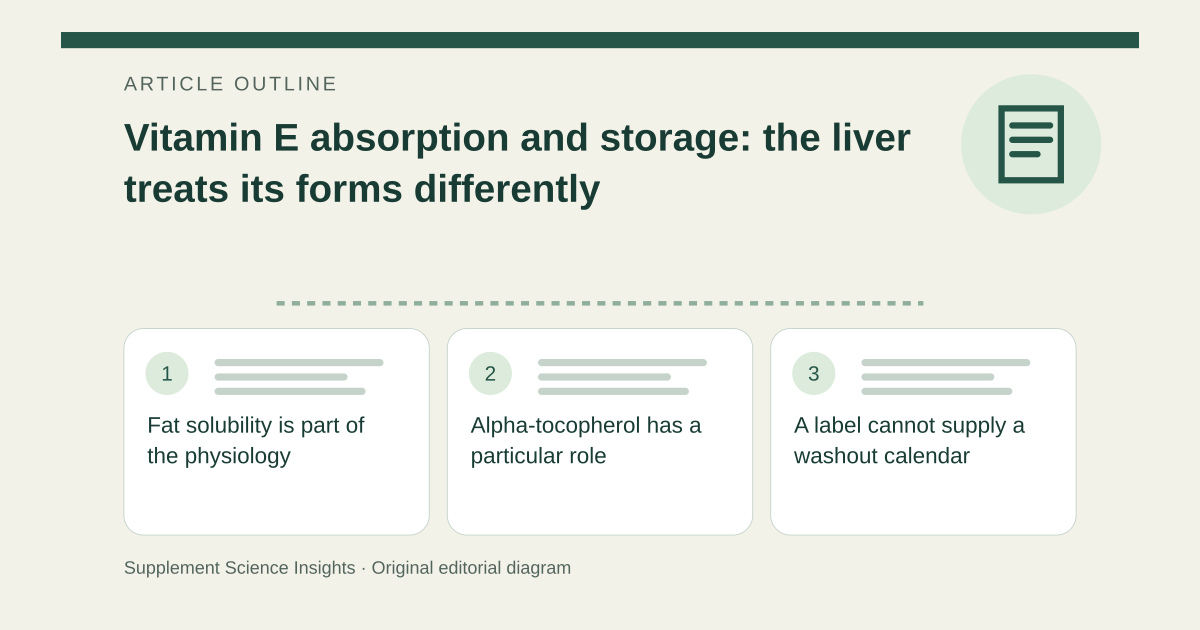
Fat solubility is part of the physiology
Vitamin E is a family of fat-soluble compounds absorbed from the small intestine. Normal fat absorption helps make the nutrient available, which is why fat-malabsorption disorders can increase deficiency risk. [1]
The phrase fat soluble does not mean that every ingested amount is stored indefinitely or that all vitamin E forms behave identically. Absorption, transport, tissue handling and elimination are different processes. [1]
Alpha-tocopherol has a particular role
ODS explains that the liver preferentially resecretes alpha-tocopherol using its alpha-tocopherol transfer protein, while other forms are more readily metabolized and excreted. Alpha-tocopherol is the form recognized for meeting human vitamin E requirements. [1]
This selective handling helps explain why a mixed-form label is not a simple statement of identical biological activity for every listed compound. It also does not prove that extra alpha-tocopherol produces additional clinical benefit. [1]
A label cannot supply a washout calendar
Imagine someone stops a vitamin E product and asks for the exact day it will be completely gone from the body. The label amount alone does not describe tissue stores, repeated exposure or individual handling.
A clinical question about surgery, bleeding or testing should go to the treating team. It cannot be settled by inventing a universal number of days from fat solubility.
| Observation | Interpretation |
|---|---|
| Fat-soluble nutrient | Uses fat-absorption and transport pathways |
| Liver preference for alpha-tocopherol | Forms are handled differently |
| Exact time to complete clearance | Cannot be inferred from the label alone |
Storage is not the only reason to review use
Vitamin E’s bleeding-related effects and medicine interactions remain relevant even when a person is focused on how long it stays in the body. Bring the actual form, amount and duration to that discussion. [1]
This page explains nutrient handling rather than prescribing a stopping interval. It does not turn a general biochemical description into a personal clearance prediction. [1]
Sources for this article
- NIH ODS — Vitamin E: Health Professional Fact Sheet
Source consulted: 2026-09-17. This is a reference resource, not a claim that we conducted the studies or tested a product.