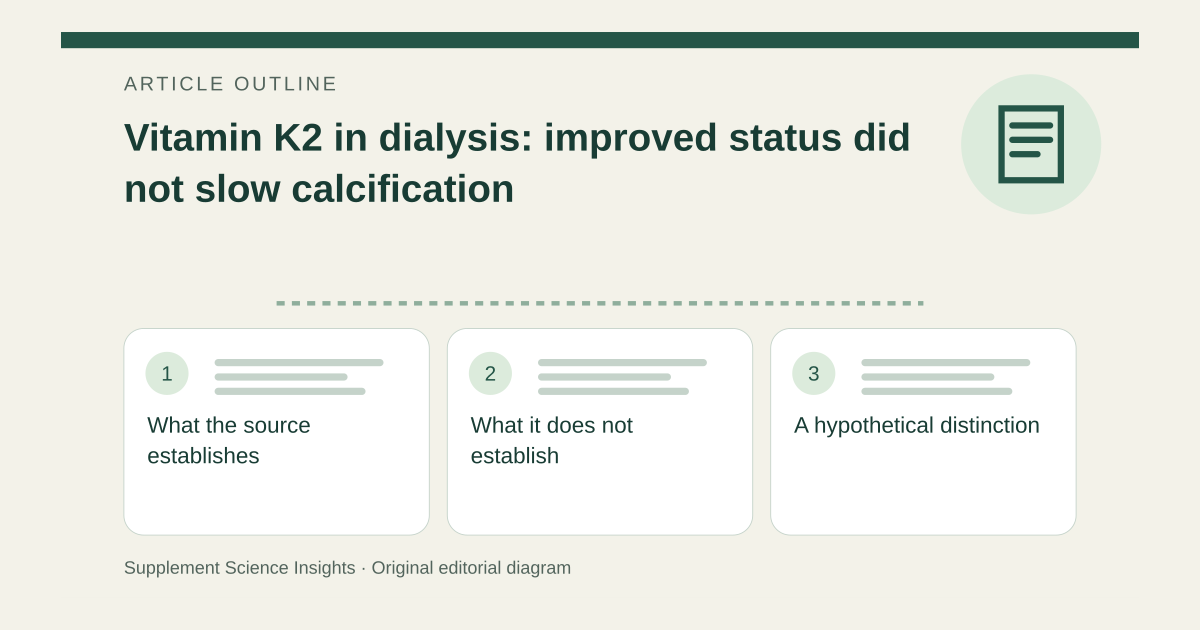
What the source establishes
Forty-eight dialysis patients were randomized to MK-7 or placebo for two years. Thirty-seven completed the first year and twenty-one the second. [1]
MK-7 increased and an inactive vitamin-K-dependent protein marker decreased. However, arterial stiffness and coronary or abdominal-aortic calcification comparisons did not show significant treatment benefits. [1]
What it does not establish
The small remaining sample limits precision. A higher nutrient concentration cannot establish kidney repair or cardiovascular protection, and this dialysis study does not determine suitability for every stage of kidney disease. Funding and conflicts were not established from the abstract. [1]
A hypothetical distinction
Imagine a supplement corrects a biochemical indicator while the imaging endpoint does not improve. Target engagement and clinical or structural benefit remain different claims.
| Detail | Interpretation |
|---|---|
| Biochemical status | Improved |
| Vascular endpoints | No significant benefit |
| Attrition | Limits precision |
Sources for this article
- Vitamin K supplementation and arterial calcification in dialysis: results of the double-blind, randomized, placebo-controlled RenaKvit trial - PubMed
Source consulted: 2026-09-19. This is a reference resource, not a claim that we conducted the studies or tested a product.