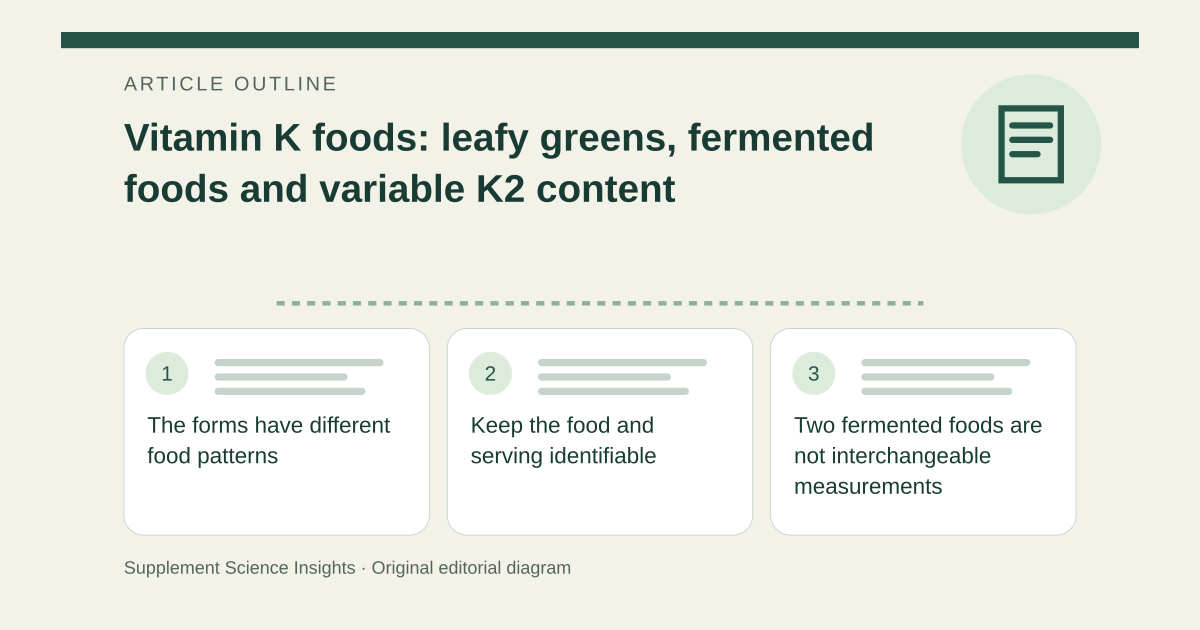
The forms have different food patterns
Vitamin K1, or phylloquinone, occurs primarily in green leafy vegetables and also in vegetable oils and some fruits. Menaquinones, collectively called vitamin K2, occur in some fermented and animal foods. Natto is a particularly rich menaquinone source in the ODS summary. [1]
A food category is not a precise nutrient analysis. Cheese, for example, can contain menaquinones, but the forms and amounts vary with bacterial strains and fermentation conditions. Calling a product fermented does not establish a fixed K2 dose. [1]
Keep the food and serving identifiable
Food-composition comparisons need the particular food, portion and preparation. An entry for one leafy vegetable or fermented preparation should not be assigned to another merely because the foods look similar. [1]
K1 content is better characterized in many food databases than the full menaquinone profile. A blank or incomplete K2 value should remain unknown rather than be treated as zero or filled in from an unrelated food. [1]
Two fermented foods are not interchangeable measurements
Imagine someone reads a high vitamin K2 value for natto and uses it to estimate the K2 in a serving of another fermented food. The microbes, ingredients and preparation differ, so that calculation has no established basis.
The correct next step is finding composition data for the actual food or retaining the uncertainty. A supplement-equivalence claim would require still more information.
| Point | Interpretation |
|---|---|
| Specific leafy vegetable and portion | Defines a K1 food entry |
| Fermented food identity | K2 content varies by preparation |
| Unknown menaquinone profile | Do not substitute another food’s value |
Do not remove vegetables automatically on warfarin
ODS emphasizes consistent vitamin K intake for people taking warfarin and similar medicines. The key issue is a change in intake affecting treatment, not a universal rule that all vitamin-K-containing foods are forbidden. [1]
Discuss major menu changes or new supplements with the anticoagulation team. This article identifies sources; it does not set an individual food restriction or medication adjustment. [1]
Sources for this article
- NIH ODS — Vitamin K: Health Professional Fact Sheet
Source consulted: 2026-09-17. This is a reference resource, not a claim that we conducted the studies or tested a product.