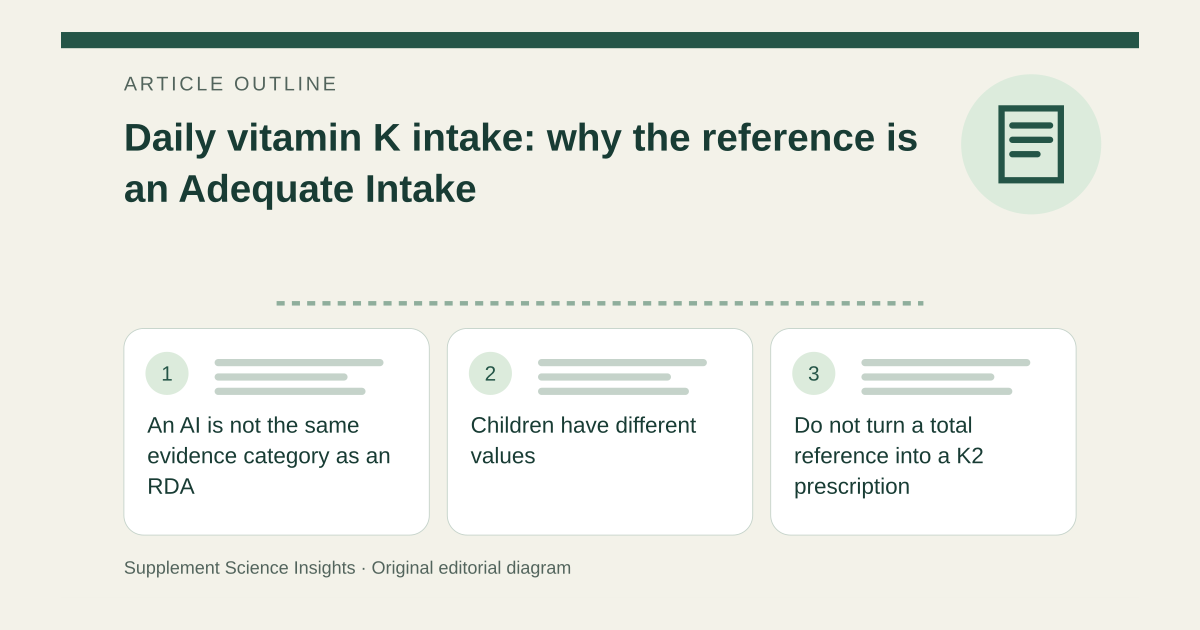
An AI is not the same evidence category as an RDA
The Food and Nutrition Board established an Adequate Intake, or AI, for vitamin K because the evidence was insufficient to set an Estimated Average Requirement and Recommended Dietary Allowance. The AI is a planning reference based on observed intakes in healthy groups. [1]
For adults, the AI is 120 micrograms daily for men and 90 micrograms for women, including during adult pregnancy and breastfeeding. These amounts refer to total intake. They do not specify that all vitamin K must come from a supplement or from one menaquinone form. [1]
Children have different values
The AI is 30 micrograms at ages 1–3, 55 micrograms at ages 4–8, 60 micrograms at ages 9–13 and 75 micrograms at ages 14–18. Infant reference values use a different basis and assume recommended vitamin K prophylaxis at birth. [1]
A numerical food-intake reference is therefore not an alternative to the newborn vitamin K intervention. Nor should an adult K2 product be selected for a child by simply scaling down the adult serving. [1]
Do not turn a total reference into a K2 prescription
Imagine a woman reads the adult 90-microgram AI and assumes she needs a 90-microgram MK-7 capsule in addition to meals. The reference does not identify that extra amount as missing or establish a preference for MK-7.
A useful review begins with usual food intake and the reason supplementation is proposed. The AI helps frame adequacy; it does not choose a treatment.
| Point | Interpretation |
|---|---|
| AI rather than RDA | Reflects the available evidence |
| 90 micrograms for adult women | Total vitamin K, not an extra MK-7 dose |
| Warfarin use | Requires consistency and treatment-specific review |
Consistency matters with vitamin K antagonists
People taking warfarin or similar vitamin K antagonists need consistent vitamin K intake because sudden changes can alter the anticoagulant effect. Changes to food or supplements should be discussed with the prescribing team. [1]
Meeting a general nutrition reference and managing anticoagulant treatment are related but distinct tasks. Do not change a prescription or supplement schedule solely to reach a number in a table. [1]
Sources for this article
- NIH ODS — Vitamin K: Health Professional Fact Sheet
Source consulted: 2026-09-17. This is a reference resource, not a claim that we conducted the studies or tested a product.