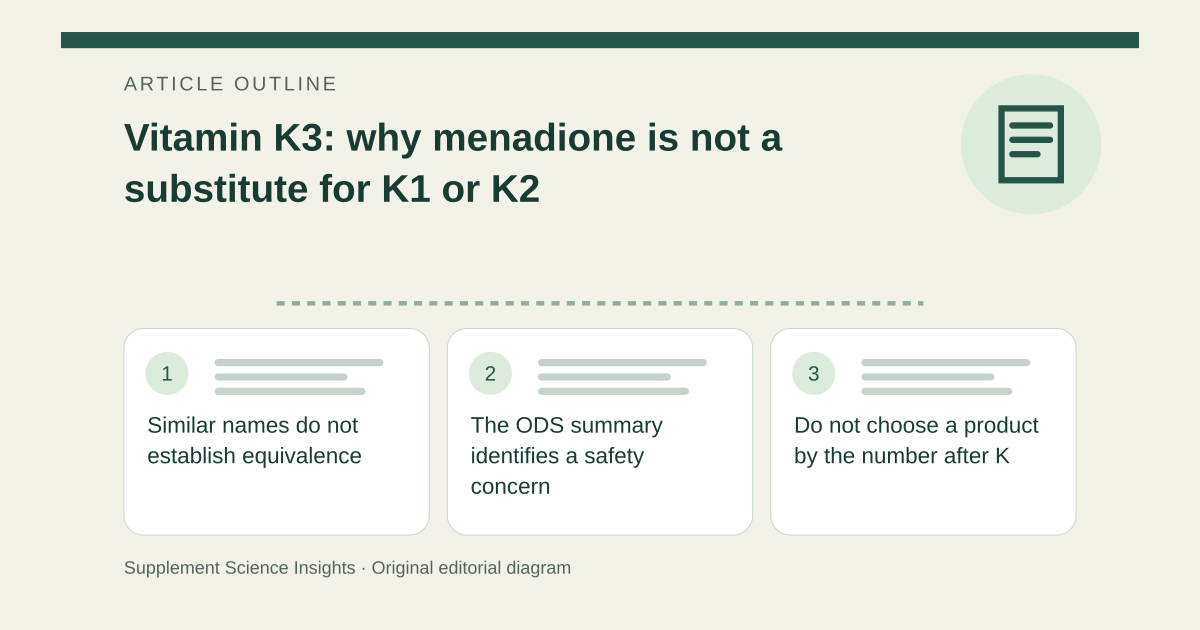
Similar names do not establish equivalence
Vitamin K1 refers to phylloquinone, while vitamin K2 describes a family of menaquinones. Menadione is another synthetic compound sometimes called vitamin K3. The numbering does not rank these substances from weakest to strongest or oldest to best. [1]
A claim about one compound should remain attached to that compound. Neither a shared vitamin-family label nor similar spelling establishes the same use, preparation or safety. [1]
The ODS summary identifies a safety concern
ODS reports that menadione damaged liver cells in laboratory studies and states that it is no longer used in dietary supplements or fortified foods. That is an important distinction from the K1 and K2 forms described in human supplements. [1]
The laboratory finding is not a basis for calculating a safe self-administered K3 dose. This page does not recommend menadione products or translate animal-feed use into human instructions. [1]
Do not choose a product by the number after K
Imagine someone assumes that K3 must be an upgraded version of K2 and searches for a stronger supplement. The premise is wrong: the names identify different compounds, not successive generations of a product.
The appropriate label review establishes the actual substance and intended use. If those details are unclear, the uncertainty should be resolved rather than filled in from the name.
| Point | Interpretation |
|---|---|
| K1 | Phylloquinone family terminology |
| K2 | Menaquinone forms need specification |
| K3 or menadione | Different compound and safety history |
Keep nutrition and research uses separate
A compound appearing in laboratory research or another setting does not establish suitability as a nutritional supplement. Experimental findings require their own context and cannot be converted directly into a retail recommendation. [1]
For questions about vitamin K intake or prescribed care, discuss established human preparations with a qualified clinician. No treatment amount or product endorsement follows from this comparison. [1]
Sources for this article
- NIH ODS — Vitamin K: Health Professional Fact Sheet
Source consulted: 2026-09-17. This is a reference resource, not a claim that we conducted the studies or tested a product.