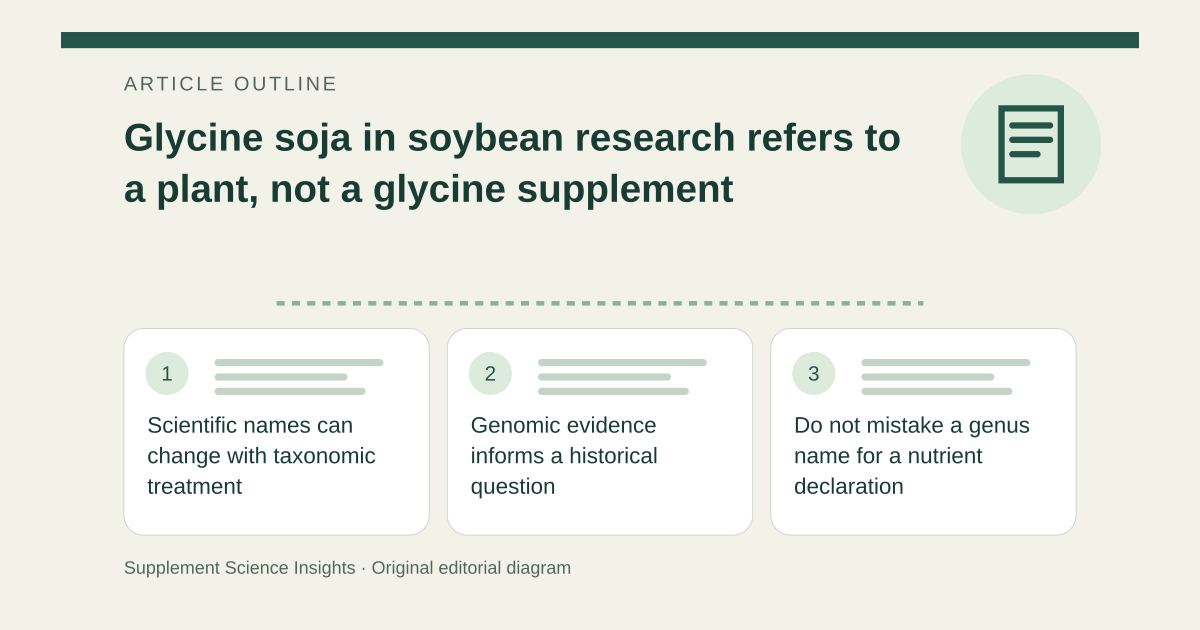
Scientific names can change with taxonomic treatment
Kew currently accepts Glycine max subsp. soja and includes Glycine soja among its synonyms. Older genomic papers commonly use G. soja for wild soybean and G. max for the cultivated form. [1][2]
Recognizing this naming difference helps connect botanical records with research literature without treating the names as unrelated ingredients. [1][2]
Genomic evidence informs a historical question
Kew gives the wild taxon’s native range as the Russian Far East to China and temperate East Asia. The cited review describes the conventional account in which cultivated soybean was domesticated from wild soybean, while also discussing an alternative shared-ancestor hypothesis. Domestication refers to selection and change under cultivation; these sources do not justify reducing that history to one unqualified event. [1][2]
The cited review compares structural genomic variation and discusses domestication-related traits such as flowering time and disease resistance. It also describes competing interpretations of soybean ancestry. [1][2]
This is evidence about plant history and selection, not a trial showing that a wild-soy ingredient is more nutritious or clinically superior. A historical hypothesis should remain qualified rather than presented as a settled single event. [1][2]
Do not mistake a genus name for a nutrient declaration
Imagine a botanical record lists Glycine soja. It identifies a soybean taxon; it does not state how many milligrams of the amino acid glycine a product supplies.
| Detail | Interpretation |
|---|---|
| Glycine soja | Wild-soy name used in research |
| Taxonomic synonym | Connects naming systems |
| Nutrient content | Requires separate composition data |
Sources for this article
- Glycine max subsp. soja (Siebold & Zucc.) H.Ohashi | Plants of the World Online | Kew Science
Source consulted: 2026-09-18. This is a reference resource, not a claim that we conducted the studies or tested a product. - Tracing soybean domestication history: From nucleotide to genome - PMC
Source consulted: 2026-09-18. This is a reference resource, not a claim that we conducted the studies or tested a product.