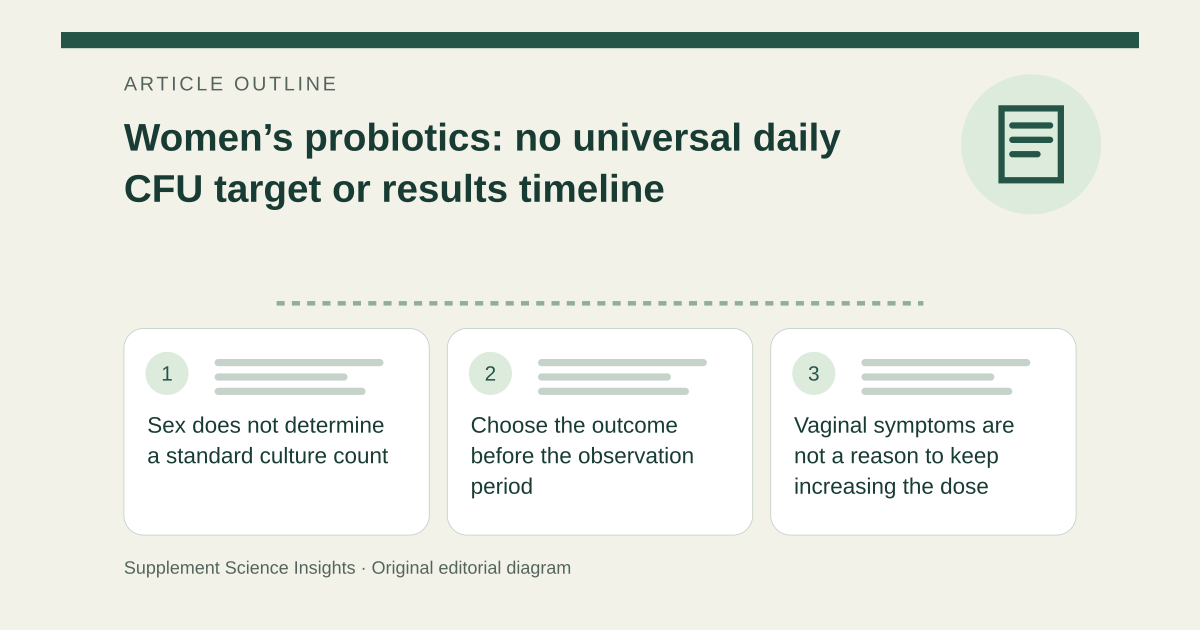
Sex does not determine a standard culture count
NIH evaluates probiotics by organism, strain, preparation and outcome. That approach does not yield one daily CFU target for every woman. A larger number or more strains is not evidence of a stronger or faster clinical effect. [1]
Choose the outcome before the observation period
A digestive symptom, recurrence of an infection and an undefined balance claim require different evidence. Use the study population and duration relevant to the exact product rather than a generic promise that all women notice changes in a week or month. No universal timetable follows from the category. [1][2]
Vaginal symptoms are not a reason to keep increasing the dose
CDC guidance does not establish probiotic products as replacement or adjunctive treatment for bacterial vaginosis, or as an evidence-supported treatment for vaginal candidiasis. Persistent symptoms need assessment. Adding CFUs cannot supply missing evidence or establish the diagnosis. [3][4]
Review the whole preparation and personal risks
Check the named strains, storage instructions, viable amount through shelf life and all additional ingredients. Severe illness or immunocompromise requires particular caution with live-microbe products. A women’s marketing label does not remove those safety considerations. [1][2]
Avoid an automatic escalation rule
Imagine no change occurs after several days. Before doubling the amount, ask whether there was a supported use and a measurable goal in the first place. For a clinician-directed course, review the planned duration and next step with that clinician. [1]
| Question | Useful evidence |
|---|---|
| How many CFUs? | Exact strain and studied purpose |
| How soon? | Relevant outcome and follow-up period |
| Persistent vaginal symptoms? | Diagnosis and appropriate treatment |
Sources for this article
- Probiotics - Health Professional Fact Sheet
Source consulted: 2026-09-21. This is a reference resource, not a claim that we conducted the studies or tested a product. - Probiotics: Usefulness and Safety | NCCIH
Source consulted: 2026-09-21. This is a reference resource, not a claim that we conducted the studies or tested a product. - Bacterial Vaginosis - STI Treatment Guidelines
Source consulted: 2026-09-21. This is a reference resource, not a claim that we conducted the studies or tested a product. - Vulvovaginal Candidiasis - STI Treatment Guidelines
Source consulted: 2026-09-21. This is a reference resource, not a claim that we conducted the studies or tested a product.